
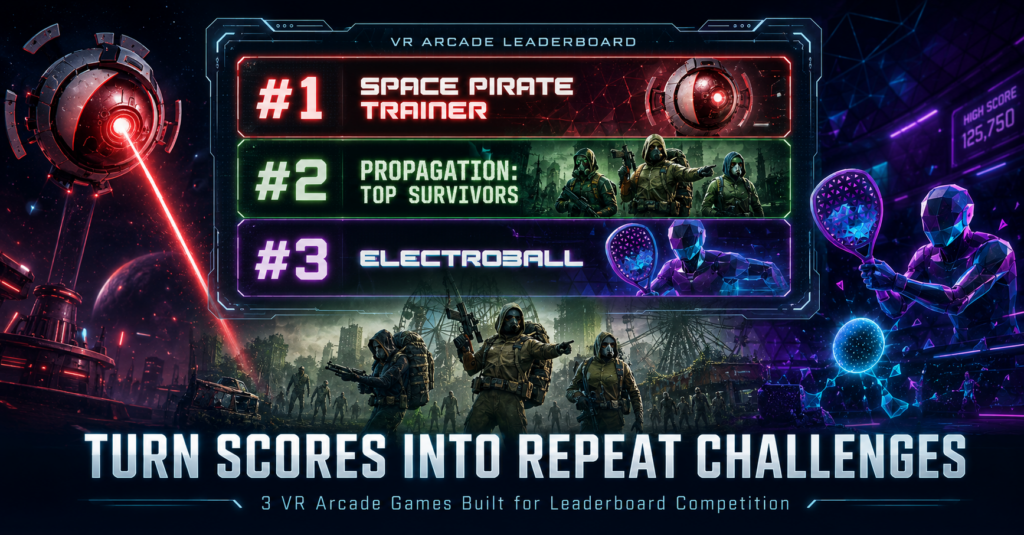
A VR session can end when the headset comes off. A score gives the player something to take with them.
They may have beaten their friend, missed the venue record by a few points, or discovered that someone else moved ahead of them after they left. Suddenly, there is a reason to come back. There is a number to beat.
For VR arcade operators, that competitive loop can extend the value of content already running in the venue. Daily high scores, weekly challenges, tournaments, and a visible Hall of Fame can turn individual sessions into something players continue talking about after they leave.
Leaderboard competition does not have to work the same way in every game. One title can reward an individual high score. Another can give a group a shared benchmark. A direct competitive game can turn every match into a rematch opportunity.
We picked three leaderboard-supported VR arcade games from the SynthesisVR content marketplace that approach that idea in very different ways.
How does the SynthesisVR Leaderboard work in a VR arcade?
The SynthesisVR Leaderboard Add-on automatically captures scores and rankings from supported VR games and displays the results in real time. Operators can run the leaderboard application on a Windows PC or Android device, including a front-desk screen, tablet, or TV.
That gives the venue several ways to build competition around existing sessions. Operators can run local tournaments, display high scores on digital signage, create weekly challenges, or keep a longer-running Hall of Fame without asking staff to record every result manually.
For a location-based entertainment VR venue, the important part is what happens after the score appears. Put the week’s best result on a screen near the front desk and the next player already knows what they need to beat.
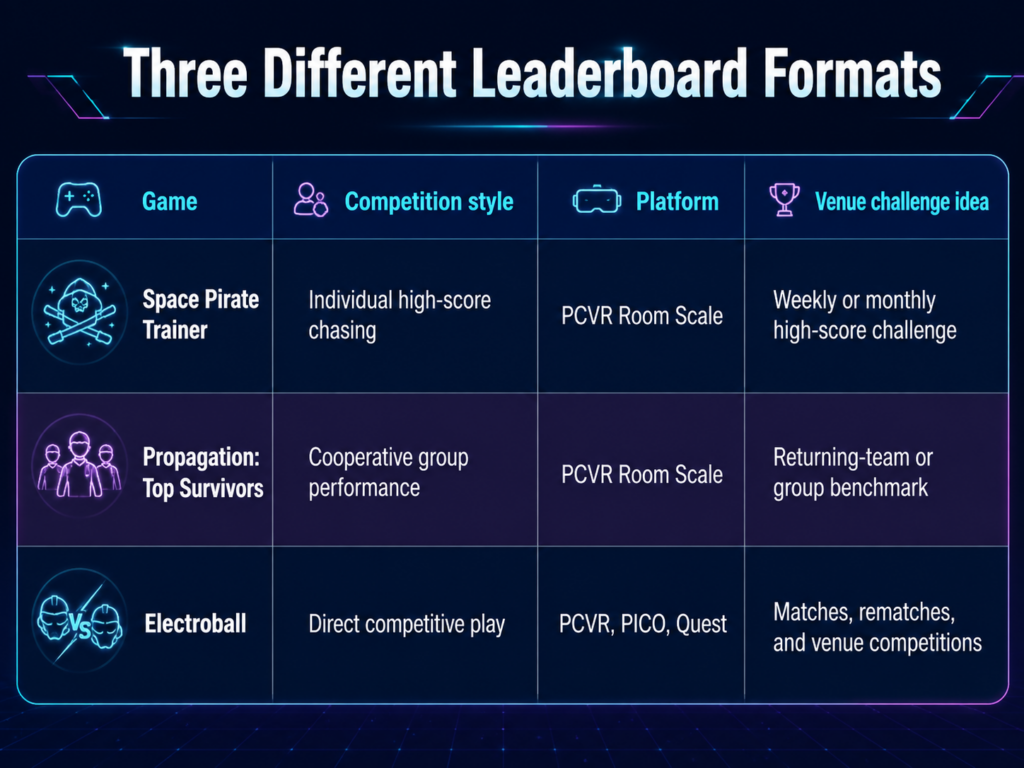
Three different leaderboard formats
Space Pirate Trainer: the classic arcade high-score loop

Space Pirate Trainer takes the logic of a traditional arcade cabinet and puts the player inside it.
Players face waves of incoming droids, dodge lasers, and switch between weapons and gadgets while trying to push their score higher. Score chasing is part of the game’s identity. Its commercial listing explicitly frames the challenge around reaching the top rankings and entering the Space Pirate Trainer hall of fame. The title runs on PCVR in a room-scale setup.
That makes the competitive objective easy for both staff and guests to understand.
Finish the run. Check the score. Decide whether it is good enough.
For an operator, very little additional explanation is needed to turn that into recurring programming. The venue could promote the highest score of the week, keep a monthly record, challenge customers to beat a staff score, or leave one long-running venue record for regular players to chase.
It is the closest of these three games to the traditional arcade leaderboard model, which also makes it a useful starting point for venues introducing score-driven competition.
Propagation: Top Survivors: make the group result matter

Competition does not always require players to fight each other.
Propagation: Top Survivors puts up to eight players together as survivors trying to make their way through a zombie-filled city. The team must reactivate ARES military anti-zombie devices before time runs out, with configurable session durations available for venue operations. The experience runs on PCVR room scale.
That changes the leaderboard conversation.
A birthday party, group of friends, or returning team already leaves with a shared story about what happened during the session. A leaderboard result gives that group an additional benchmark to remember and another target for a future visit.
Instead of asking only, “Did we finish it?”, returning players have another question to answer: Can we improve on our last result?
That makes cooperative competition particularly useful for venues serving repeat groups. The players can work together inside the game while still competing against their own previous performance or results set by other teams.
Top Survivors also sits within the wider Wanadev catalog now available through SynthesisVR, alongside titles from the Propagation series and the former Octopod VR catalog.
Electroball: competitive VR across PCVR and standalone

Electroball takes the leaderboard idea in another direction.
Players enter an electrified arena and use rackets to redirect balls into the opponent’s goal while defending their own. Balls can bounce from the arena walls, so positioning and timing influence how players create scoring opportunities.
The objective is immediate. Score more than the other player.
That makes the result easy to understand and gives the loser an equally obvious reason to ask for another round.
Electroball also stands out in this group because of its hardware flexibility. The title supports PCVR Room Scale, PICO, and Quest, making it relevant to standalone VR arcades as well as traditional PCVR installations. It is available in English, French, and Spanish and is designed to be accessible to beginners.
For operators, that creates a useful combination: a simple competitive concept, a measurable outcome, and support across several common commercial VR hardware setups.
It is also a good example of why browsing a VR content marketplace by operational feature can be more useful than simply looking at the most familiar titles. A smaller game can fill a very specific role in the attraction mix.
Turn leaderboard results into venue programming
The game provides the result. The venue decides how visible and valuable that result becomes.
A leaderboard can sit on a TV near reception with the week’s top scores. Regular players can return every Friday to defend their position. Birthday groups can compete internally. Staff can set a score for customers to beat. A venue can run a one-night tournament or keep a long-term record that becomes part of the local player community.
The format does not need to be complicated.
A simple “Beat this week’s score” challenge gives players a clear target before they enter the headset. A monthly reset gives more customers a realistic chance to reach first place. Keeping an all-time record alongside the monthly leaderboard gives the strongest players something harder to chase.
Visibility matters. If the result disappears as soon as the headset comes off, much of the competitive value disappears with it.
The SynthesisVR Leaderboard Add-on connects supported game results to the wider VR arcade management setup, with automated score and time tracking, instant updates, tournament date filtering, and display options for Windows and Android devices.
Space Pirate Trainer, Propagation: Top Survivors, and Electroball show three ways operators can put that system to work: individual score chasing, cooperative group performance, and direct competitive play.
Explore the SynthesisVR Leaderboard-supported game library and find the titles that fit your venue’s next challenge.