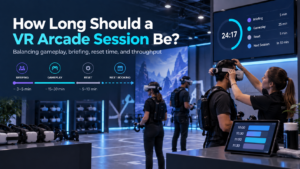
There is no standard VR arcade session length.
Commercial VR experiences currently range from a few minutes for fast competitive rounds to 30 or 45 minutes for free-roam missions and narrative experiences. Some venues then add another 10 to 15 minutes for briefing, headset fitting, and preparation.
For an operator, the useful question is therefore: How much gameplay creates a satisfying experience while still fitting the attraction, audience, booking schedule, and operating model?
The answer starts by separating three different clocks that often get grouped together as “session length.”
Gameplay Time, Booking Time, and Operating Time Are Different
A customer might book 30 minutes of VR, but the attraction can occupy venue capacity for much longer.
Consider the full cycle:
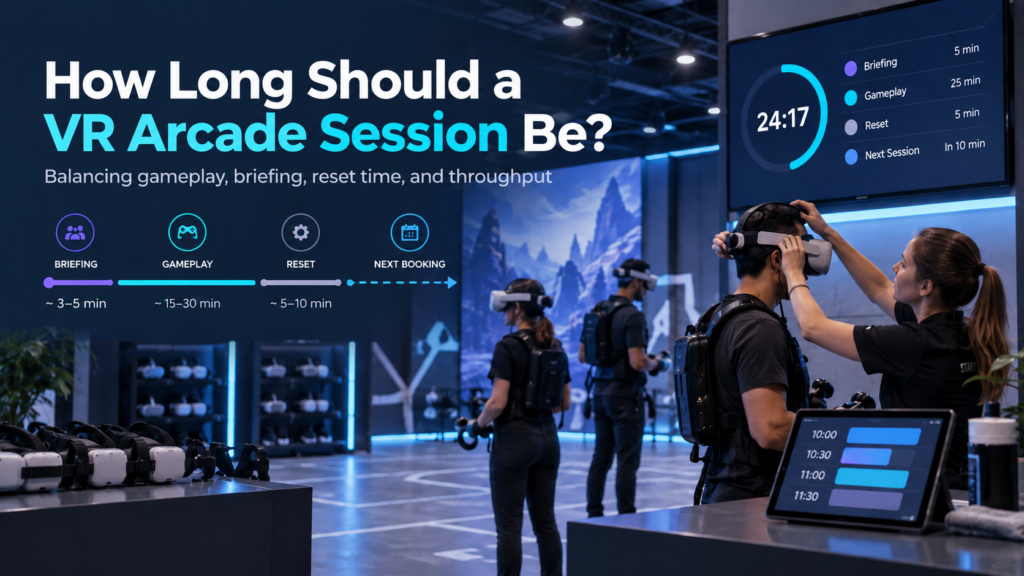
Briefing and fitting → Launch → Gameplay → Exit → Reset
If guests play for 30 minutes, need 10 minutes for preparation, and staff need another 5 minutes before the next group, the attraction occupies a 45-minute operating block.
That distinction matters because the game duration does not determine how many sessions a venue can actually run.
The previous SynthesisVR guide on VR attraction performance looked at this from the measurement side. A nominal 30-minute attraction can become a 40-minute or 45-minute cycle once onboarding, launch, and reset enter the calculation.
For session planning, operators should define three times clearly:
| Time | What it measures |
| Gameplay time | Minutes the customer actively spends inside the experience |
| Guest booking time | The time the customer should allow for the booked activity |
| Operating cycle | Time from preparing one group until the attraction is ready for the next |
Commercial VR Already Uses Very Different Session Lengths
Current commercial VR formats show why one universal session duration would make little sense.
Some HOLOGATE arena titles support playtimes as short as 3, 5, 8, or 10 minutes. SynthesisVR marketplace title Critical Mass lists an approximate session duration of 10 to 15 minutes. Teller Falls can run individual themes in roughly 10 to 15 minutes or its complete experience in 25 to 30 minutes.
At the other end, Zero Latency offers formats built around 15- and 30-minute sessions and currently offers some experiences in 30- and 45-minute versions. VR escape venues commonly advertise around 40 to 45 minutes of actual play, with preparation extending the complete visit toward an hour.
The range reflects different products.
A five-minute competitive match can produce a complete result, a winner, and an immediate rematch.
A 30-minute cooperative mission needs enough time for the group to progress through the experience.
An escape-style attraction needs time for exploration, puzzles, and narrative development.
The operator should start with what the experience needs to feel complete, then build the commercial session around it.
Match Session Length to the Experience Structure
Session duration works best when it follows the natural rhythm of the content.
Fast competitive games often lend themselves to shorter rounds because the outcome arrives quickly. Scores, wins, losses, and leaderboards create natural stopping points. Customers can play again without repeating a long introduction.
Cooperative shooters and free-roam missions usually need more time to establish the objective, let the team settle into its roles, and give players a meaningful progression.
Narrative and escape experiences generally need longer uninterrupted periods because their value comes partly from completing a story or solving a sequence of challenges.
That does not mean every competitive game should run for ten minutes or every escape game should run for 45. The current commercial market already contains plenty of exceptions.
A better operator question is:
At what point does this specific experience feel finished rather than cut short?
That becomes the starting duration to test.
Shorter Sessions Do Not Automatically Mean Better Throughput
Short sessions create more theoretical booking slots, but every session carries some fixed operational time.
Imagine two formats.
Format A
15 minutes gameplay
10 minutes briefing and fitting
5 minutes reset
30-minute total cycle
Format B
30 minutes gameplay
10 minutes briefing and fitting
5 minutes reset
45-minute total cycle
Format A can theoretically complete two cycles per hour. Format B completes around 1.3.
But look at the same example from the customer’s side.
In Format A, only 50% of the attraction cycle is gameplay.
In Format B, gameplay accounts for roughly 67% of the cycle.
That gives operators a useful planning calculation:
Playable-Time Ratio
Gameplay time ÷ full operating cycle × 100
This is not an established industry KPI. It is a simple planning measure that helps show how much of each operating block goes toward the experience customers actually came to play.
The highest ratio does not automatically produce the best business model either. A short competitive attraction can work extremely well when customers replay it, groups move through quickly, or the format supports walk-ins. A longer session may suit private bookings or premium experiences.
The calculation simply exposes the tradeoff.
Longer Sessions Have Their Own Limits
Adding more gameplay time can increase perceived value, but only while the experience continues to hold the player’s attention and comfort.
VR research does not support one universal maximum session duration. Exposure time interacts with content, locomotion, software design, and individual susceptibility. Research into cybersickness has found substantial variation between users and between different types of VR content.
For an arcade operator, that makes observation more useful than adopting a generic rule.
Watch when customers naturally want to stop. Track early exits. Listen for complaints about fatigue or discomfort. Compare first-time visitors with experienced players.
An intense free-movement shooter and a calm exploration experience can place very different demands on players over the same 30 minutes.
Group Size Changes the Session Before Gameplay Even Begins
Session length should also be tested with the group size the venue actually expects to serve.
Preparing two experienced players can take very little time.
Preparing six or eight first-time visitors may involve headset assignment, fitting, player identification, explanation, calibration, multiplayer connection, and questions from several people at once.
The SynthesisVR multiplayer guide makes this operational difference clear: even a small repeated step can become several minutes of preparation when staff must perform it across a larger group.
This is one reason maximum player capacity and session design belong together.
A six-player attraction that works perfectly during an internal two-person test may behave differently during a Saturday birthday booking with six children who have never used VR.
Test the complete session with the group size you intend to sell.
Tell Customers How Much Time They Will Actually Spend Playing
Session length also affects how clearly the venue can sell the experience.
Current venue websites use the word “session” in very different ways.
Virtual Arena describes a 45-minute VR experience containing approximately 30 minutes of gameplay, with the remaining time covering equipment, briefing, preparation, photos, and scores. Virtual Zone describes approximately 45 minutes of gameplay plus preparation, bringing the full session close to an hour.
Both models can work. The important part is clarity.
A booking page can simply state:
30 minutes of gameplay. Allow approximately 45 minutes for the complete experience.
Or:
45-minute private VR experience, plus approximately 10 minutes for briefing and preparation.
Customers can then compare the offer accurately and plan around it.
This becomes especially important for birthdays, corporate events, school groups, and customers with another booking afterward.
Build Reset Time Into the Calendar
Reset time should sit inside the operating model from the beginning.
Cleaning headsets, checking equipment, resetting the play space, recovering devices, and preparing the next group all consume real minutes. The earlier SynthesisVR free-roam operations series explored this through the 15-minute reset cycle. When a venue books groups back to back without enough room for those tasks, delays begin accumulating through the day.
The goal is to protect both gameplay time and schedule reliability.
If the attraction consistently needs ten minutes between groups, putting five minutes into the calendar will not make the operation faster. It will make the venue late.
Run several complete cycles before publishing the schedule and use what actually happens on the floor.
One Venue Can Support More Than One Session Length
A VR venue does not necessarily need a single session duration across every attraction.
Different products can serve different booking needs.
A shorter format can work well for walk-ins, first-time trials, competitive rounds, or customers combining VR with other attractions.
A longer format can work well for private groups, free-roam missions, escape experiences, or customers visiting specifically for VR.
Operators can also offer different durations around the same content when the experience supports it. Teller Falls, for example, allows shorter individual themes or the complete 25- to 30-minute experience.
The venue then needs to decide whether customers should choose the duration themselves or whether staff and the booking flow should guide them toward the most suitable format.
Too many time options can make a booking page harder to understand. A small number of clearly differentiated products usually tells the customer more.
Test the Full Session Before Setting the Schedule
Before adding a new session duration to the booking page, run the complete customer journey.
Time the group from arrival through the moment the attraction becomes ready for another booking.
Record:
| Stage | What to check |
| Briefing and fitting | Can staff complete it consistently with the expected group size? |
| Time to action | How quickly does the full group reach meaningful gameplay? |
| Gameplay | Does the experience feel complete at the planned duration? |
| Exit | Do players leave naturally or feel interrupted? |
| Reset | How long before the attraction can accept another group? |
| Replay behavior | Do customers want another round immediately? |
Then repeat the test with different staff members and different group sizes.
A duration that only works when the most experienced employee runs the attraction is difficult to build a reliable booking schedule around.
Session Length Should Also Fit the Booking Model
The commercial offer matters alongside the game itself.
A customer buying a quick walk-in activity wants low commitment and a fast start.
A birthday organizer wants predictable timing.
A corporate organizer may care more about keeping several groups on schedule than maximizing every participant’s headset time.
A repeat customer may prefer two competitive rounds over one longer continuous session.
That connects session length directly to pricing and packaging. The existing SynthesisVR pricing guide makes the broader point that customers often buy an occasion or outcome rather than a block of headset minutes.
Session duration should support that promise.
Use the Management Layer to Enforce the Session You Designed
Once the venue decides how its experiences should run, the operating system needs to follow the same rules.
SynthesisVR Experience Types allow operators to define session duration, pricing, station limits, and the interval between booking slots. The booking system can preselect a duration or hide time options that the venue does not want customers booking online. Operators can therefore structure different session models around different attraction types rather than forcing every experience into one format.
That operational consistency becomes increasingly important as the venue adds more content, hardware, group types, and booking formats.
The customer should experience a simple product.
The complexity stays behind the counter.
So, How Long Should a VR Arcade Session Be?
Start with the experience.
Find the amount of gameplay that produces a satisfying ending. Add the real time required to prepare the group and reset the attraction. Test that complete cycle with the group size and staff members who will actually run it.
Then compare the result with the booking product you are trying to sell.
For some attractions, that may produce a 10- or 15-minute experience. For others, 30 or 45 minutes will make more sense.
The strongest VR arcade session length is the one customers understand, the content can support, and the venue can deliver consistently throughout a busy operating day.
Frequently Asked Questions About VR Arcade Session Length
What is a good VR arcade session length?
There is no universal duration. Current commercial VR experiences range from short competitive rounds of only a few minutes to 30- or 45-minute free-roam and escape experiences. Operators should base the duration on the content, audience, group size, operating cycle, and booking model.
Is 15 minutes enough for a VR arcade session?
It can be. Short competitive, introductory, or repeatable experiences can work well within 10 to 15 minutes. Narrative and escape-style content generally needs more time to reach a satisfying conclusion.
Should briefing time count as VR session time?
Operators should distinguish briefing and preparation from actual gameplay, even when both sit inside the customer’s booking window. Clear booking pages tell customers both how long they will play and how much total time they should allow.
How much time should a VR arcade leave between bookings?
The required buffer depends on headset cleaning, hardware checks, reset requirements, group size, and launch workflow. Operators should measure several real resets and schedule from the observed time rather than choosing an arbitrary buffer.
Can a VR arcade offer different session lengths?
Yes. Different attraction types and customer groups can justify different durations. SynthesisVR also supports configurable Experience Types and booking durations, allowing operators to structure several session formats within the same venue.