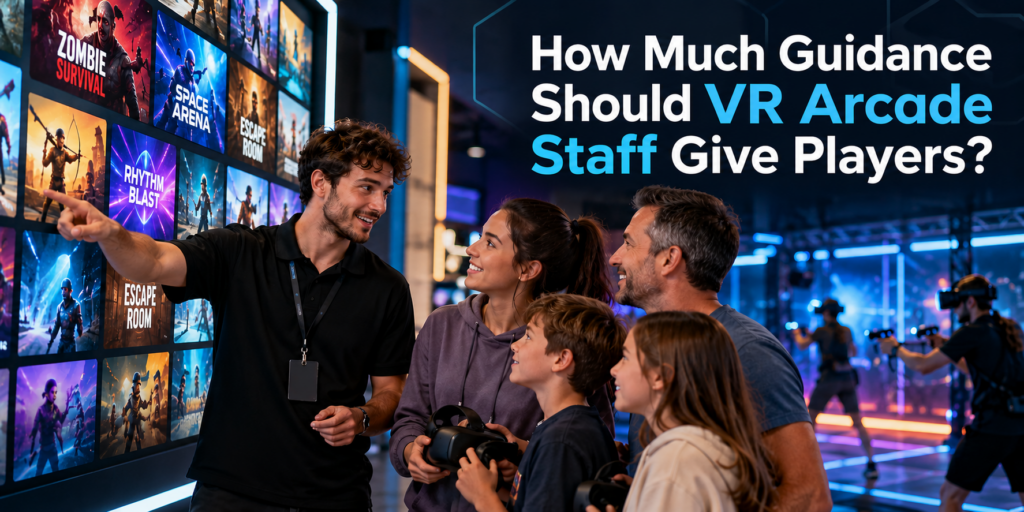
A strong VR content library gives customers choice, but choice alone does not guarantee a good experience. Staff still need to understand who an experience is for, how it starts, what players need to know before putting on the headset, and when they may need help.
That makes staff guidance an important part of running a VR arcade, particularly for first-time visitors who have little idea what to choose or what to expect.
Why VR Players Need More Guidance Than They May Realize
Experienced VR players may arrive knowing exactly what they want. Many customers do not.
A family with children, a birthday group, two adults trying VR for the first time and a group of experienced gamers can all walk into the same venue with very different expectations.
Asking them to browse a large game library without guidance puts much of the decision on the customer.
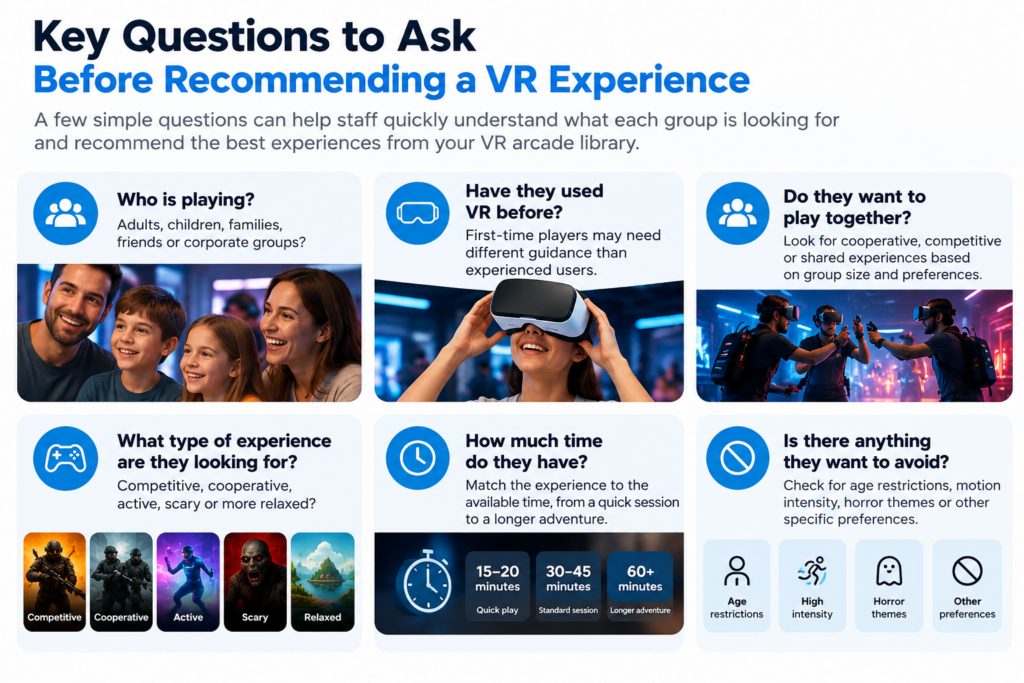
The goal is not to make the decision for the customer. It is to turn a potentially overwhelming library into a manageable set of experiences that fit the group.
Staff Should Know the Content They Are Offering
This was one of the interesting issues raised in our recent conversations with VR arcade operators.
Adding an experience to the library and waiting to see whether customers play it provides limited information about whether the content itself is working.
A game may receive little play because customers cannot tell what it is from the title or thumbnail. Staff may rarely recommend it. Players may start it without understanding the objective. A group may choose something poorly suited to its size or experience level.
The operator can then conclude that customers simply do not like the game.
That conclusion may be wrong.
Before staff recommend an experience, they should ideally know:
What is the experience about?
Staff should be able to explain the basic premise in one or two sentences.
Who is it suitable for?
Consider age, VR experience, group size, physical intensity and genre.
How does the experience begin?
Some games are immediately intuitive. Others require players to understand controls, roles or objectives before the session starts.
What commonly causes players difficulty?
Knowing where people tend to get stuck allows staff to intervene quickly instead of leaving players frustrated.
What hardware and play space does it require?
A recommendation still has to work with the venue’s available setup.
This is one reason properly testing VR arcade games before adding them to the active library matters. Staff who have actually played an experience can explain it much more naturally than staff working from a title and description alone.
Guidance Starts Before the Headset Goes On
Some of the most useful guidance happens before gameplay begins.
A good introduction does not need to become a five-minute tutorial. In many cases, players only need a few pieces of information:
What am I trying to do?
Give the player the objective.
What do I need to know to get started?
Explain the essential controls or interaction.
What should I expect?
If players will move between stages, communicate with teammates, physically turn around or encounter something intense, tell them beforehand.
This is especially important with first-time VR users. They are learning the game and learning how to interact in VR at the same time.
Giving them the right information before the session can reduce confusion once the headset is on.
During the Game, Help Without Taking Over
There is another extreme operators should avoid: over-guiding.
A puzzle is less satisfying if a staff member immediately gives away the solution. Exploration loses its appeal if someone constantly tells players where to go. Experienced players may want very little assistance.
The best level of support therefore changes with the player and the experience.
Staff should know when a player is discovering and when a player is simply stuck.
Someone experimenting with different solutions may be enjoying the game exactly as intended. Someone repeating the same failed interaction for several minutes may need a small prompt.
Start with the least intrusive intervention:
Prompt → hint → explanation → direct assistance
That preserves player agency while preventing frustration from consuming a large part of a paid session.
Technical Problems Need Fast Intervention
Gameplay guidance and technical support are different.
If tracking fails, a controller disconnects, a headset loses connection or the game does not progress correctly, waiting for the player to solve the problem wastes session time.
Staff need enough familiarity with both the content and the venue setup to recognize when the problem is technical.
This becomes particularly important during busy periods. A problem that takes an experienced staff member 30 seconds to identify can consume several minutes when the person supervising the session does not know what normal gameplay should look like.
Knowing the game is therefore part of troubleshooting it.
Better Recommendations Can Improve Content Utilization
Staff knowledge also affects which games get played.
Imagine a venue has 40 experiences available, but employees confidently recommend only five because those are the games they know best.
From the customer’s perspective, the venue effectively has a five-game library.
The remaining content may be technically available, but it is doing little work for the business.
Training staff across a carefully selected range of experiences can help venues make better use of the content they already license. It also gives operators better information when deciding what to keep, rotate or replace.
Instead of asking only:
“How often was this game launched?”
operators can also ask:
“Did we recommend it to the right customers?”
That is a much more useful question when evaluating content performance.
Build a Simple Content Knowledge System for Staff
Staff do not need to memorize every detail of every game.
A simple internal reference can make recommendations much easier. For each active experience, record:
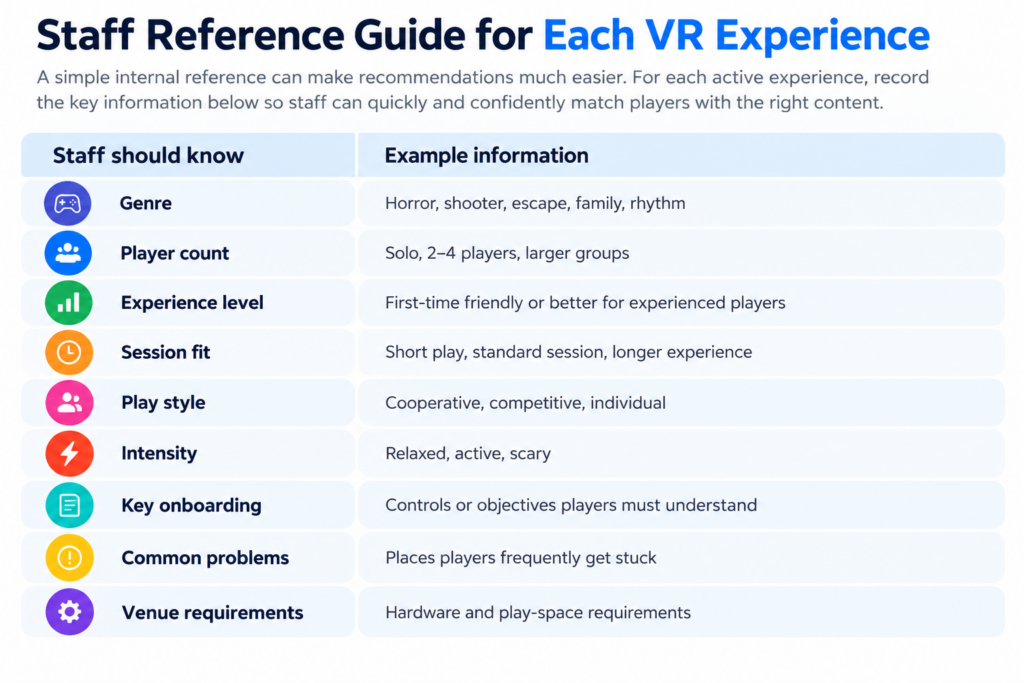
This also makes onboarding new employees easier. Rather than expecting them to learn an entire commercial VR library at once, operators can establish a core group of experiences every staff member should know well and expand from there.
Let Your VR Management System Handle the Library, and Let Staff Handle the Guest
Good software can make content available, help operators manage sessions and organize a commercial VR library. The human part of the experience still matters.
SynthesisVR gives operators access to commercial VR content alongside the tools needed to manage and launch experiences across a venue. Staff can then focus on the part software cannot replace: understanding the group standing in front of them and helping them have a good session.
The combination matters.
A well-managed content library makes experiences available. A knowledgeable team helps customers find the right ones.
So, How Much Guidance Should VR Arcade Staff Give?
Enough to remove unnecessary confusion, without removing discovery.
For some customers, that means recommending three suitable games and helping them choose. For a first-time player, it may include a short explanation before the headset goes on. During an escape experience, it might mean watching for genuine frustration before offering a hint. When something breaks, it means intervening immediately.
The appropriate level changes from player to player.
What should remain consistent is the staff’s knowledge of the experience they are delivering.
A VR arcade does not need employees hovering over every session. It needs employees who know when their help will make the session better.
Related Reading
How to Test VR Arcade Games Before Adding Them to Your Library
A practical framework for evaluating gameplay, hardware compatibility, onboarding and venue fit before making an experience available to customers.
VR Arcade Management Software: What Operators Actually Need
A look at the tools that help venues manage content, sessions and day-to-day VR arcade operations.