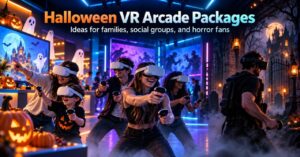
Halloween gives VR arcades an easy reason to change what customers see, promote experiences that may spend less time in the spotlight during the rest of the year, and create a seasonal offer around content they already have access to.
The timing matters. Halloween VR arcade packages should be ready before customers start deciding what to do in late October.
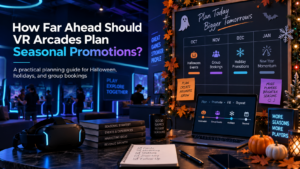
In our recent guide to planning VR arcade seasonal promotions before demand peaks, we suggested starting internal planning around six to eight weeks before a major event, followed by the main customer-facing campaign roughly four to six weeks ahead. For Halloween 2026, that window is already open. Operators starting now still have time to choose content, define the offer, test the experience, prepare the booking page, and begin promotion well before October 31.
The offer itself can stay simple. A venue might sell a themed block of VR time with several Halloween game choices. Another might add snacks, drinks, a group photo, or a small Halloween treat. A free-roam venue can reserve the arena for a dedicated spooky session. The right format depends on who the venue wants to bring in.
Start With the Audience Before Choosing the Scare
Halloween content covers a much wider range than traditional horror.
A family with younger players may want pumpkins, ghosts, candy, and supernatural themes without intense scares. A group of teenagers or young adults may want something more suspenseful, social, or competitive. Adult groups can move into darker escape experiences, psychological horror, zombies, and stronger jump scares.
That is why the content decision should start with the customer rather than the genre.
The same principle applies throughout the year. Our guide to choosing VR arcade games for different customer groups looks at audience fit alongside hardware, available space, player capacity, session length, and staff workflow. A Halloween campaign simply gives operators a seasonal reason to apply the same process.
A useful starting point is to define the intensity of each Halloween offer clearly. Labels such as Family Spooky, Scary, and Full Horror can help customers understand what they are booking before they arrive.
Turn Halloween Content Into a Bookable Package
A seasonal offer works better when customers can understand it in a few seconds.
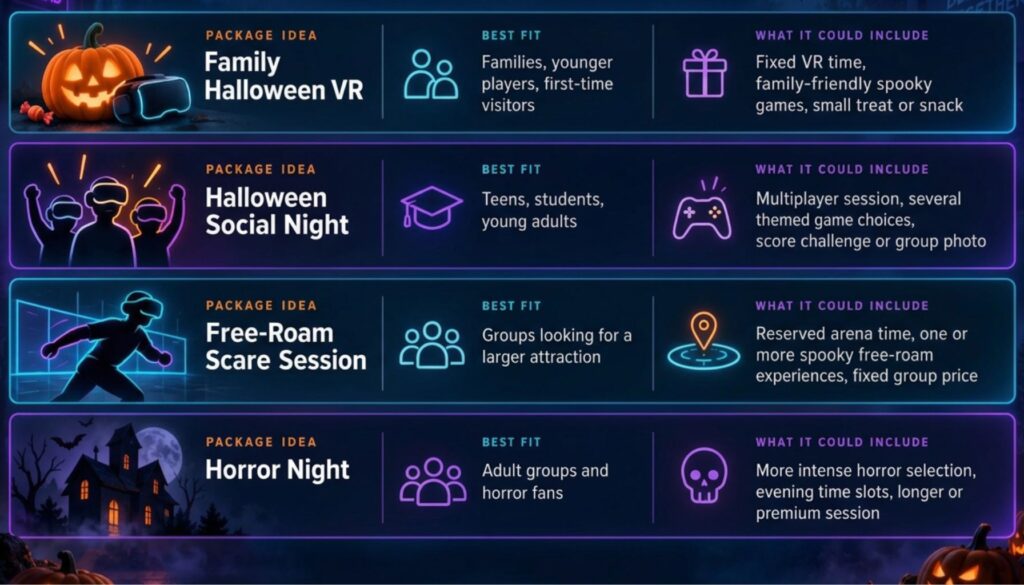
The venue can keep the entry-level package focused entirely on VR. Food, drinks, party space, or other extras can sit in higher tiers if the operation supports them.
The packaging principles are similar to those we covered in our guide to VR arcade birthday party packages. Customers respond better when the total visit length, group size, price, session format, and included extras are clear before checkout.
For Halloween, the additional question is simple: How scary is this going to be?
Answer that on the booking page.
Where to Find Halloween VR Content
Operators running PCVR and room-scale stations can start with the dedicated Halloween VR content category. It currently brings together titles such as Halloween Candy Reclaim, The Obsessive Shadow, Fear of the Dark, Cosmodread, Dreadhalls, Escape Bloody Mary, and AFFECTED: The Manor, among others.
Free-roam operators should also browse the dedicated SynthesisVR free-roam library. The free-roam section separates content by setups including PCVR, PICO, HTC Focus, and Quest, which matters when an operator needs Halloween content that fits an existing arena rather than a room-scale station.
That distinction also helps operators avoid choosing a Halloween title based on theme alone and discovering later that the platform, player count, or physical footprint does not fit the venue.
Family-Friendly Halloween VR
Family Halloween content can use the season without turning the visit into a horror experience.
Halloween Candy Reclaim is a PCVR room-scale example built specifically around that idea. Players use pickle guns while recovering stolen candy from Halloween creatures. The experience describes itself as family-friendly and intentionally non-scary, with pumpkins, ghosts, skeletons, candy, seven levels, multiple difficulty settings, and local multiplayer.
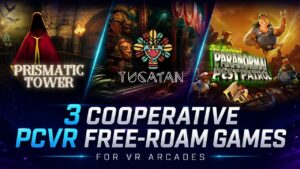
For a free-roam setup, Paranormal Pest Patrol offers another direction. Groups become paranormal exterminators dealing with mischievous demons inside a possessed house. Its comedic tone, simple controls, puzzle structure, E10+ rating, and support for groups of two to eight players make it easier to position as a spooky group adventure rather than full horror.
Either could sit inside a family package with a fixed session length, Halloween snack, photo spot, or small treat at the end.
The commercial value comes from the packaging. Parents do not need to understand the difference between every title in the library. They need to know that the experience fits their group and that nobody is walking into something far scarier than expected.
Give Social Groups Something Spookier
Older groups give operators room to increase the intensity.
Fear of the Dark runs on PCVR room-scale and supports multiplayer for up to five people. Players protect the torch carrier while moving through a village filled with zombies, werewolves, monsters, bats, and other threats. Multiple difficulty settings give operators some flexibility around the group they are serving.
Free-roam venues can look at experiences such as The Hallow, a PCVR free-roam title for two to eight players. Its supernatural 19th-century premise sends the group searching for abnormal activity under the guidance of a mysterious magician.
This type of content can support a Halloween social offer aimed at friend groups, students, and young adults. The marketing can focus on bringing the group together, choosing how brave they want to be, and booking a fixed evening slot.
We covered the wider booking behavior of this audience in How VR Entertainment Centers Attract Student Groups and Young Adult Audiences. Social-first promotion, clear pricing, multiplayer content, and a quick mobile booking path become especially relevant when the customer may decide on the activity with friends only a few days before the visit.
Build a Stronger Horror Option for Adults
Some customers will actively search for the most intense experience the venue can offer.
For PCVR room-scale stations, AFFECTED: The Manor focuses heavily on atmosphere, lighting, audio, and a guided route through a haunted environment. Its design also makes it easy for friends to watch someone else navigate the experience, which can work well as part of a Halloween challenge format.
For free-roam venues, Mansion of Death provides a much larger group format. The haunted escape experience supports PCVR, PICO, Quest, and Focus 3 / Vision, with arena configurations scaling from one player in a 5 × 5 meter space to groups of up to ten in a 10 × 10 meter arena.
Teller Falls provides another PCVR free-roam horror option. The psychological horror experience supports up to six players in roughly a 9 × 9 meter space. Operators can run the full 25 to 30 minute experience or select individual scare themes for shorter 10 to 15 minute sessions.
That flexibility creates several possible commercial offers. One venue might sell a single premium horror session. Another might combine two shorter experiences. A third could run evening-only free-roam horror bookings throughout October.
Use Halloween to Rotate Attention, Not Just Content
A Halloween campaign does not require an entirely new VR library.
An experience can sit inside a venue for months and still be new to most customers if it has rarely appeared in marketing or staff recommendations.
Our guide to VR arcade content rotation looks at seasonal rotation specifically. Horror experiences can move forward before Halloween, while family titles, multiplayer content, or other categories take the spotlight at different points in the year.
That approach also gives operators more marketing material from the content they already license.
A Halloween landing page, email campaign, short gameplay clips, staff recommendations, in-venue screens, social posts, and a themed package can all point toward the same small selection of experiences for several weeks.
Start the Marketing Before the Final Week of October
With Halloween on October 31, the campaign should build rather than appear all at once.
Right now, operators can finalize the audience, games, pricing, package structure, booking dates, and landing page. Late September and early October can introduce the offer and show what customers will actually experience. Gameplay footage, group reactions, scare-level explanations, player counts, and clear pricing become useful at this stage.
During the final two weeks, the message can shift toward specific available dates and times, weekend plans, remaining group slots, and last-minute Halloween activities.
The campaign can also change by customer type.
A family sees a seasonal activity for the kids. A group of friends sees a Halloween night out. Horror fans see a challenge. A free-roam customer sees an experience that goes beyond something they can reproduce at home.
The underlying content may overlap, but the reason to book changes.
Keep the Operational Side Simple
Once the campaign starts generating bookings, staff need to deliver the experience customers saw online.
Within SynthesisVR, operators can manage commercial VR content across room-scale, PCVR, standalone, multiplayer, and free-roam setups while adjusting the attraction mix for different audiences and seasonal campaigns. That makes it easier to feature Halloween content for several weeks and then rotate attention toward the next seasonal opportunity without rebuilding the venue workflow around every campaign.
The marketing promise and the session customers receive should match.
Build the Halloween Offer Now
Halloween customers will range from families looking for light seasonal fun to groups actively searching for a frightening VR experience.
Start with the audience. Decide the scare level. Choose content that fits the hardware, play space, group size, and session model. Then turn those choices into a package with a clear price and an easy booking path.
Operators looking for PCVR and room-scale options can browse the Halloween VR category, while venues building an arena-based offer can explore the wider free-roam VR library.
Build the offer now, start promoting it ahead of October, and give customers a clear reason to choose your venue for Halloween.