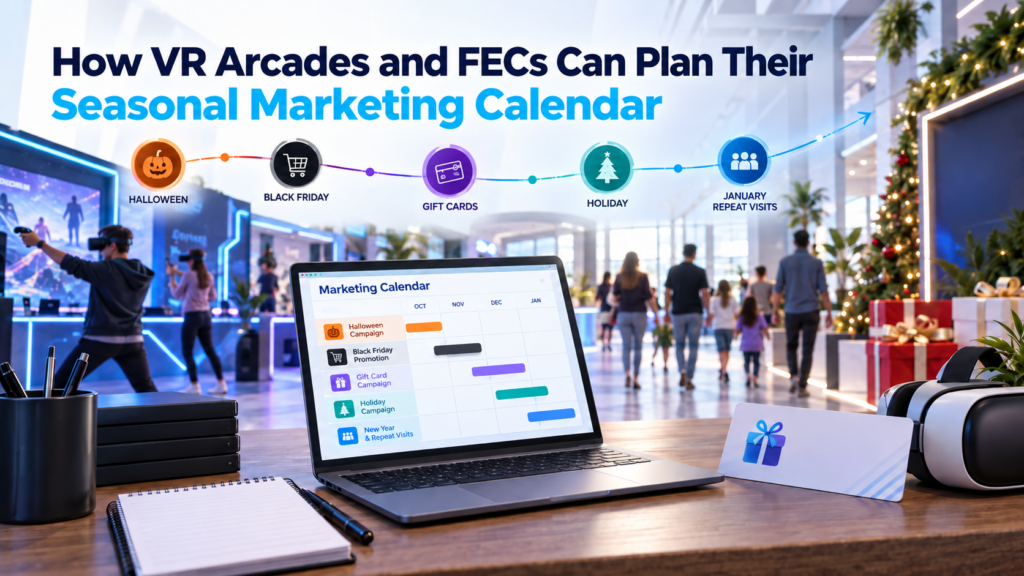
Seasonal marketing for VR arcades works best when the calendar tells the team more than what to post next.
A useful seasonal marketing calendar should show who the venue wants to reach, what behavior the campaign should create, which offer fits that audience, how operations will deliver it, and what should happen after the visit.
That matters because Halloween, Black Friday, Christmas, school breaks, corporate party season, and January do not create the same type of demand. A campaign that works for families during a school holiday may have little relevance to a corporate organizer planning a December event or somebody buying a VR experience as a Christmas gift.
For VR arcades and family entertainment centers, there is another layer. The experience itself can change. Operators can rotate content, feature different multiplayer experiences, build seasonal packages, run competitions, and adapt the attraction mix without rebuilding the venue around every campaign.
The result is a marketing calendar that connects customer demand with what the venue can actually deliver.
Start with the moments that change customer behavior
A seasonal calendar does not have to begin with a list of holidays.
Start with the periods when the behavior of your customers changes.
School breaks create family availability. Halloween creates demand for themed entertainment. November introduces holiday shopping and Black Friday. December can bring corporate parties, gift buying, visiting families, and school vacations. January may bring quieter general traffic alongside customers redeeming gifts they received during the holidays.
Even the customer’s planning window can begin surprisingly early. The National Retail Federation reported that by early August 2026, one-quarter of consumers surveyed had already purchased at least one Halloween item. (National Retail Federation)
For a physical entertainment venue, the relevant calendar also depends on its local market. A tourist destination, suburban family entertainment center, university-town arcade, and city-center VR venue can experience very different demand patterns.
Bob Phibbs, The Retail Doctor, makes a related point in his guidance for seasonal brick-and-mortar businesses: seasonal demand is often connected to the occasion behind the purchase, including gifting and travel, rather than simply the date printed on the calendar. (Retail Doc)
Before filling the calendar with promotions, operators should therefore ask:
What changes in our customers’ lives during this period that gives them a reason to visit us?
That question usually produces a better campaign than beginning with, “What should we post for Halloween?”
Give every seasonal campaign one commercial job
Seasonality creates attention. The venue still needs to decide what it wants that attention to accomplish.
A Halloween campaign might exist to increase evening bookings among teens and young adults. A corporate Christmas campaign could target higher-value group reservations. A Black Friday offer might generate advance revenue through gift cards. A January campaign could encourage people who visited or received a gift during December to come back.
This connects with the pricing framework we explored in our guide to VR arcade session prices, packages, and promotions. A promotion works better when the operator defines the behavior it should create before choosing the discount or package.
A simple seasonal campaign might therefore have a goal such as:
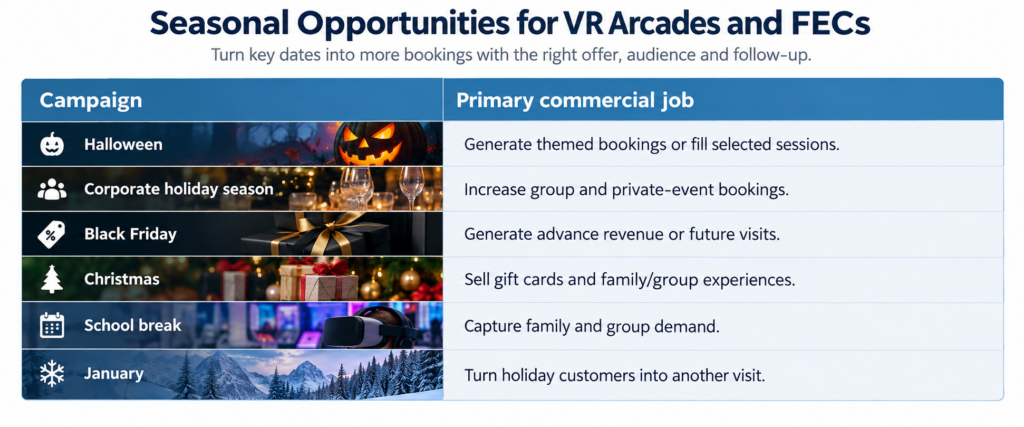
This also makes measurement easier. The operator already knows what success should look like before the campaign launches.
Build each promotion around four connected layers
A practical way to plan each seasonal campaign is what we can call the Seasonal Campaign Stack.
Every campaign needs four layers:
Demand: Who has a reason to visit during this period?
Offer: What gives that customer a clear reason to book?
Delivery: Can the venue reliably provide the experience being promoted?
Follow-up: What should happen after that visit?
Consider Halloween.
Demand might come from friend groups, families, teenagers, or adults looking for something different to do around October 31.
The offer could be a horror VR package, competitive Halloween night, family-friendly spooky session, or themed free-roam experience.
Delivery means checking the content, licensing, player capacity, session length, staff briefing, booking flow, and hardware before the promotion goes live.
Follow-up could move those customers toward a November event, Christmas gift card, new multiplayer experience, or another reason to return.
We covered the package-building side in more depth in How to Build Halloween VR Arcade Packages for Different Audiences.
The same four questions can then be reused for Black Friday, Christmas, Valentine’s Day, spring break, summer, back-to-school season, and local events.
Choose the audience before choosing the message
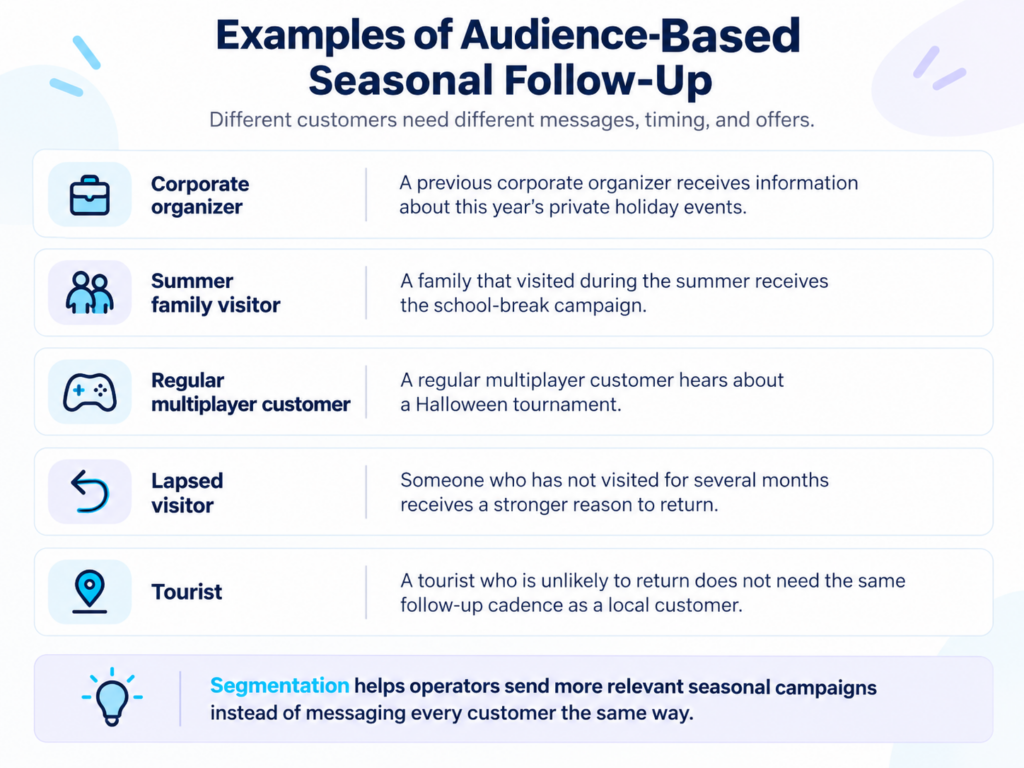
A venue may have several very different audiences inside the same customer database.
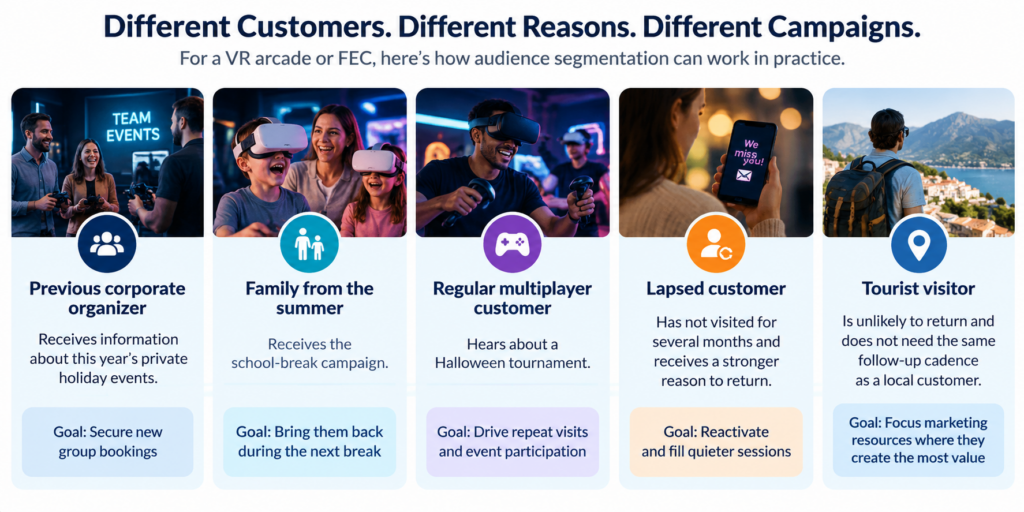
A birthday parent, local teenager, tourist, corporate organizer, repeat player, and someone who bought a gift card are all customers. Their reasons for booking are completely different.
This is especially important for email marketing.
Neil Patel’s current guidance on email personalization emphasizes behavioral and transaction data rather than relying only on basic personalization such as a customer’s name. Segmentation can use previous purchases, engagement, location, behavior, and customer lifecycle stage to make the message more relevant. (Neil Patel)
For an entertainment venue, that might mean:
We explored this segmentation further in How VR Entertainment Venues Turn First-Time Visitors Into Repeat Customers.
This is also why the seasonal calendar and the email calendar should eventually connect. Wednesday’s deeper email-marketing article can build on this part without repeating the whole seasonal strategy.
Plan the content calendar with the marketing calendar
This is where VR venues have an advantage over many traditional brick-and-mortar businesses.
The building may stay exactly the same while the experience customers come to play changes.
A horror title can move into the spotlight for Halloween. Competitive multiplayer can support a tournament or social event. Family-friendly experiences can lead during school breaks. Cooperative content may fit corporate or group campaigns.
That means operators can plan what they promote and what customers will play at the same time.
Our guide to VR arcade content rotation looks at this in more detail. Rotation does not always require licensing something new. Operators can feature an existing title, introduce a leaderboard, run a challenge, change staff recommendations, or bring an overlooked experience forward for a particular audience. (Synthesis VR)
This creates a useful planning question for every seasonal campaign:
What will customers experience differently when they respond to this promotion?
That question becomes particularly important for repeat visitors. Telling somebody who has already visited the venue to “come try VR” provides very little new information. Showing them the competitive title, seasonal challenge, new free-roam experience, or group event available this month gives them a specific reason to return.
Check that operations can deliver what marketing promises
A campaign can look excellent online and still fail inside the venue.
Before publishing a seasonal offer, the team should run a simple promise-versus-delivery check.
If the landing page says the experience works for groups of six, can six customers actually play together?
If the package promises 60 minutes, does that represent gameplay time or the entire booking including headset fitting and briefing?
If a corporate event advertises flexible group sizes, how will staff rotate larger groups?
If an email promotes a particular game, has that experience been installed, tested, commercially licensed, and added to the staff briefing?
If a Black Friday campaign sells a large number of gift cards, how will redemption affect busy weekend capacity later?
This operational check is especially important in VR because session launches, player capacity, content licensing, hardware availability, briefing time, and reset time all affect whether the marketed experience matches the one customers actually receive.
Seasonal planning therefore belongs partly to marketing and partly to operations.
Use genuine scarcity instead of manufactured urgency
Seasonal marketing frequently uses urgency, and physical entertainment venues already have a legitimate reason to do so.
Session inventory expires.
An eight-player attraction with four remaining Friday-evening sessions has 32 remaining player positions. Once that evening passes, those positions cannot be sold later.
Robert Cialdini identifies scarcity as one of the principles that can influence decision-making, alongside factors such as social proof, and emphasizes using these principles ethically. (Influence at Work)
For a venue, that means there is little reason to manufacture fake countdowns.
“Four Halloween sessions remaining” can be meaningful when there genuinely are four sessions remaining.
“Corporate party dates filling for December” can be useful information if availability really is narrowing.
The calendar helps operators identify these capacity-sensitive periods early enough to communicate them honestly.
Give every marketing channel a specific role
A seasonal campaign rarely needs to appear everywhere in exactly the same form.
The venue website or booking page should explain the offer clearly enough to convert somebody who is ready to book.
Email can reach customers the venue already knows and segment them by previous behavior.
Social media can show what the experience actually looks like.
Google Business Profile and local search can capture people actively searching for things to do nearby, especially when seasonal opening hours, events, or offers have changed.
In-venue signage can reach customers who already crossed the hardest barrier: getting through the door.
Direct outreach can work better for audiences such as schools, community groups, and corporate organizers.
Local-search specialist BrightLocal also recommends updating seasonal opening hours, events, offers, images, and other information on Google Business Profile during holiday periods so that the information customers find online matches what the physical business is actually offering. (BrightLocal)
The goal is consistency. A customer who sees a Halloween event on Instagram should be able to find the same offer, dates, availability, and booking path when they reach the website or search for the venue on Google.
Treat gift cards as a bridge between seasons
Gift cards deserve their own place on a seasonal calendar because the sale and the visit often happen at different times.
NRF reported that gift cards were the second-most popular gift category for the 2025 holiday season, with 43% of surveyed shoppers planning to buy at least one and expected spending reaching approximately $29 billion. (National Retail Federation)
For an entertainment venue, this creates an interesting opportunity.
A gift card purchased during Black Friday or December may become a January or February visit.
Shopify’s current retail guidance specifically recommends looking at gift-card redemption as a way to generate post-holiday visits and even suggests making promotional bonus cards redeemable after the holiday period to encourage a later return. (Shopify)
For a VR arcade or FEC, the planning should go one step further.
This turns the gift card from a December transaction into part of the venue’s January customer-acquisition and retention plan.
Build the next campaign into the current one
A seasonal calendar becomes much more useful when campaigns connect.
Consider an autumn-to-January sequence:
| Period | Audience | Offer / experience | Operational check | Next step |
| Halloween | Families, teens, friend groups | Spooky content, themed package, competition | Scare level, player count, session flow | Introduce holiday events |
| Corporate holiday season | Companies and organized groups | Private/group VR experience | Capacity, rotations, food/event logistics | Add organizer to future event outreach |
| Black Friday | Existing customers and gift buyers | Gift cards or prepaid experiences | Redemption rules and future capacity | Christmas gifting |
| Christmas | Families and gift buyers | Gift cards, family sessions, group experiences | Mixed-age content and holiday hours | January visit |
| January | Gift recipients and local customers | Redemption, fresh content, return offer | Available capacity and content rotation | Build repeat behavior |
Notice what happens here.
Halloween does not simply end on October 31.
Black Friday is not simply a discount weekend.
Christmas does not end when the gift card is sold.
Each campaign creates an audience that the next campaign can work with.
That is the real advantage of planning several months at once.
Review booking behavior before repeating next year’s calendar
The final step happens after the seasonal moment has passed.
Operators should record enough information to answer a few basic questions: which audience booked, which offer converted, which channels drove bookings, what happened to average booking value, whether gift cards were redeemed, and whether those customers returned.
A high-performing social post with no bookings tells the operator something different from a modest email that generated ten private-event inquiries.
The same principle applies to the attraction itself. An event that sells well but creates delays, poor occupancy, repeated staff intervention, or other operational problems needs a different review from one that runs smoothly.
Our guide to measuring VR attraction performance covers the operational side in more depth.
Once operators combine that information with campaign performance, next year’s seasonal calendar can be built from real venue behavior rather than starting from a blank spreadsheet.
Where SynthesisVR fits
Seasonal campaigns become easier to deliver when the venue can adapt its attraction mix without rebuilding its operating process each time. SynthesisVR helps operators manage commercial VR content, licensing, sessions, and different attraction formats from one environment, making it easier to feature horror content for Halloween, group experiences for holiday events, or fresh multiplayer options for returning customers while maintaining a consistent workflow behind the campaign.
Build a calendar that continues after the holiday ends
The strongest seasonal marketing calendars connect what customers want now with what the venue wants them to do next.
Start with the customer occasion. Give each campaign a commercial purpose. Match the offer to a defined audience. Decide what content supports it. Check that the venue can deliver the promise. Then plan the follow-up before the campaign begins.
The result is more than a schedule of social posts.
It is a working plan connecting marketing, content, capacity, operations, and repeat visits across the year.
For operators preparing the next seasonal campaign, the first question is simple:
Who are we trying to bring through the door, and what should happen after they arrive?