Your next VR arcade marketing campaign might not need a new game.
It might need a better plan for a game you already offer.
Many VR arcades have multiplayer experiences that customers would enjoy but rarely discover. Operators may share a trailer on social media, add a game image to their website, or mention a title in an email. These activities can generate interest, but they do not automatically work together to produce bookings.
A successful campaign connects the game, the audience, the offer, and the booking process.
For VR arcades and family entertainment centers (FECs), this means treating one game as the foundation of a coordinated promotion rather than another piece of content to post.
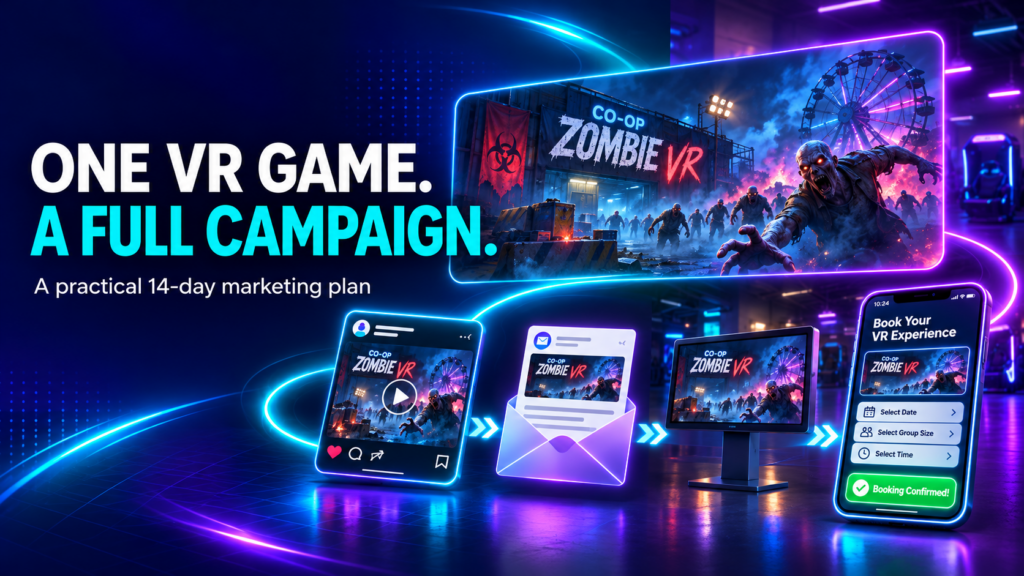
Here is how to build a practical 14-day campaign around one VR experience, prepare your venue to deliver it, and measure whether the promotion actually worked.
What Makes a VR Arcade Marketing Campaign Different From a Social Media Post?
A social media post introduces an experience, however a marketing campaign gives customers a reason to book that experience within a defined period. Here the difference is in planning.
Imagine your arcade offers a cooperative zombie survival game such as Zombie Storm. You could share its gameplay trailer with the caption, “Come play Zombie Storm this weekend.” That tells customers the game exists.
Now consider a different approach:
“Can your squad survive the outbreak? Gather your team for a cooperative VR zombie challenge this week.”
The second message gives the experience a purpose. It introduces a group activity, creates a recognizable challenge, and gives customers a reason to organize a visit. But the message alone is not enough.
A complete campaign also needs:
- One audience: The customer group you want to attract.
- One objective: The business result you want to achieve.
- One offer: The experience customers will book.
- One booking path: A clear route from promotion to reservation.
- One measurement plan: A way to evaluate the result.
Without those elements, an operator can spend two weeks producing content without knowing whether the promotion contributed to the business.
How Should VR Arcades Choose Which Game to Promote?
The newest game is not always the best campaign candidate. An established title may offer a stronger opportunity if it fits your customers, works well for groups, and has available booking capacity. Start by identifying the problem you want the campaign to solve.
Are weekday sessions underbooked? Do customers rarely try a particular multiplayer title? Are you trying to bring previous visitors back? Do you want to introduce more customers to group VR experiences?
The answer should influence which game you choose.
Before selecting a title, consider five questions.
1. Can customers understand the experience quickly?
A recognizable concept is easier to communicate than an unfamiliar game title.
“Cooperative zombie survival” immediately tells customers something about the setting and gameplay.
“Multiplayer VR experience” offers much less information.
If customers do not recognize the game, lead with the activity rather than expecting the title to sell itself.
For more on this approach, see our guide to marketing VR games around popular themes.
2. Does the game match the audience?
A competitive multiplayer title might appeal to groups of friends looking for a challenge.
A cooperative adventure may be a better fit for customers interested in teamwork.
A family-oriented experience needs suitable content, clear age guidance, and an accessible introduction.
Choose the audience before writing the advertisement.
3. Does the experience fit your booking format?
Check the supported player count, session duration, available play space, and operational requirements.
If your campaign promotes a group experience, make sure your venue can accommodate the advertised group size.
The offer must match what customers can actually book.
4. Can your team deliver the experience consistently?
Confirm that staff understand how to launch the game, assist players, and resolve common issues.
Check commercial licensing, hardware compatibility, and the availability of promotional assets.
A campaign that attracts bookings but creates operational confusion can damage the customer experience.
5. Is there capacity worth promoting?
Look for sessions that could benefit from additional demand.
For example, a venue with strong Saturday bookings but quieter Tuesday and Wednesday evenings might focus its campaign on those weekday periods.
Promoting already-full sessions may generate attention without creating much additional revenue.
The strongest campaign opportunity often sits where customer interest and unused capacity overlap.
How Do You Build a Campaign Around One Game?
Once you have selected the experience, write a short campaign brief.
You do not need a complicated marketing document. One page is enough to keep the team aligned.
Consider this illustrative example.
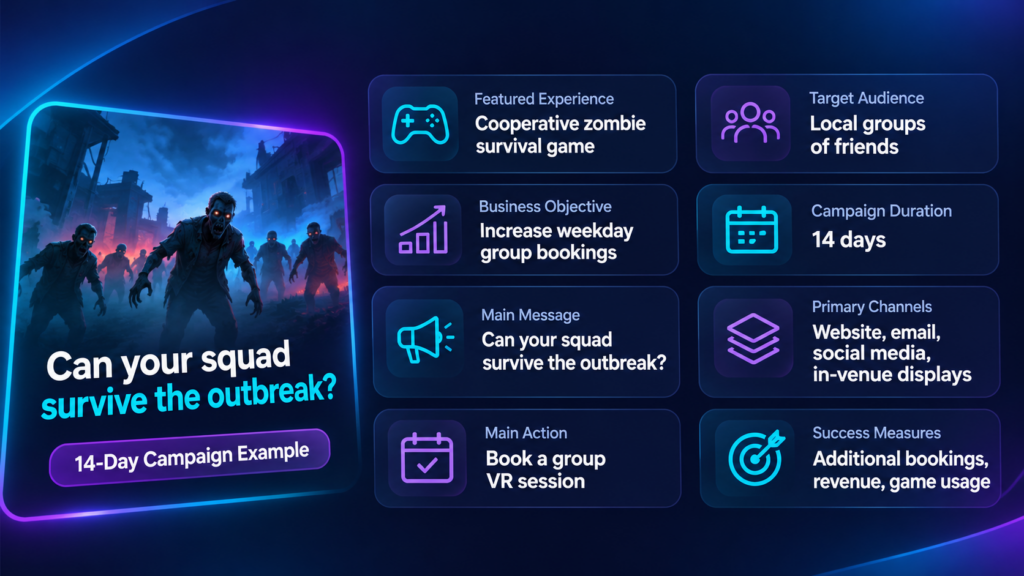
This structure prevents the campaign from becoming a collection of unrelated promotions.
It also gives staff a simple explanation of what the business is trying to achieve.
Set a measurable booking goal
Avoid vague objectives such as “increase awareness” or “get more engagement.”
Those outcomes may support a campaign, but they do not tell you whether it generated additional business.
Instead, define a measurable target.
For example:
“Generate 10 additional weekday group bookings during the next 14 days.”
This is an illustrative target, not an industry benchmark.
A suitable goal depends on your venue’s existing bookings, available sessions, pricing, audience, and marketing budget.
If your arcade normally receives 20 weekday group bookings over two weeks, you can use that figure as a starting point.
Just remember that a difference between periods does not automatically prove the campaign caused every additional booking.
How Can VR Arcades Turn a Game Into a Bookable Offer?
A campaign should be ready to book before you start promoting it.
One common problem occurs when an advertisement generates interest but sends customers to a general website page.
The customer then has to find the game, work out the available session options, check the price, and locate the booking button.
Every unnecessary step creates another opportunity to leave.
For a focused campaign, the booking experience should reinforce the advertisement.
Imagine a customer sees a short video promoting a cooperative zombie challenge.
The booking page should use the same campaign name, recognizable artwork, and customer-friendly description.
It should answer:
- What will players experience?
- How many people can participate?
- Is the game suitable for beginners?
- How long does the booked session last?
- What does the session cost?
- Which dates and times are available?
- How can customers reserve their place?
A simple campaign page might begin:
Can Your Squad Survive the Outbreak?
Bring your team together for a cooperative VR zombie survival challenge. Work together, face the threat, and see whether your group can complete the mission.
Book Your Zombie Challenge
The venue would then add its actual group size, pricing, suitability information, session duration, and availability.
Do not promise a particular number of players or a specific gameplay feature unless your licensed game and venue setup support it.
A discount is not always necessary
Some operators immediately associate campaigns with lower prices.
But a clear experience, group challenge, or dedicated booking occasion can provide a reason to visit without discounting the session.
You could test:
- A weekday group challenge
- A themed multiplayer evening
- A competition or leaderboard, if the game supports it
- A return-visit invitation for previous customers
- A group package built around an existing experience
Start with a compelling reason to book. Introduce a discount only when it serves a clear commercial purpose.
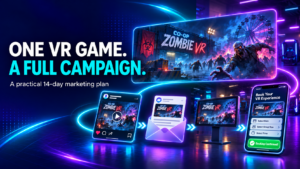
What Does a 14-Day VR Arcade Marketing Campaign Look Like?
A campaign does not need fourteen completely different advertisements.
It needs a consistent message presented through several channels, with enough time to observe what customers respond to.
Here is a practical two-week plan.
| Day | Action | Purpose |
| 1 | Publish the campaign page and confirm the booking route | Make the offer bookable |
| 2 | Send an email to relevant previous customers | Reach an existing audience |
| 3 | Publish a short gameplay video | Introduce the experience |
| 4 | Add campaign artwork to reception screens and displays | Reach customers already visiting |
| 5 | Ask staff to recommend the experience to suitable groups | Support word-of-mouth promotion |
| 6 | Share a post explaining how the group session works | Answer common booking questions |
| 7 | Review website traffic, bookings, and customer questions | Identify early problems |
| 8 | Publish a second video or image using the same campaign message | Maintain visibility |
| 9 | Send a permitted follow-up email to an appropriate audience segment | Re-engage interested customers |
| 10 | Highlight genuine remaining availability | Encourage timely booking |
| 11 | Review feedback from staff and customers | Improve unclear information |
| 12 | Share a customer reaction or group photo, with permission | Show the experience in context |
| 13 | Remind customers when the campaign ends | Communicate the final booking opportunity |
| 14 | Close the campaign and record results | Evaluate what worked |
This is a planning example. Adjust the schedule to your venue’s opening days, customer booking habits, and available resources.
The important point is that every activity supports the same offer.
Use existing game marketing assets
You may not need to create all the visuals yourself.
Developer-provided trailers, screenshots, artwork, and logos can provide a starting point for campaign materials, subject to the relevant usage permissions.
Use those resources consistently across your website, social channels, emails, and venue displays.
For instructions on finding and using these resources, read our guide to VR game marketing assets.
Give each channel a specific job
Different channels contribute at different stages of the customer journey.
Social media introduces the experience to potential customers.
Your website explains the offer and helps visitors decide whether to book.
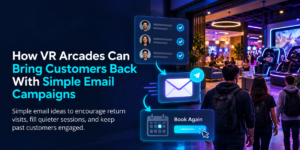
Email gives previous customers a reason to return.
In-venue screens introduce additional experiences to people already visiting.
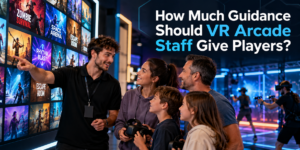
Staff recommendations help customers understand whether the game suits their group.
The message should remain recognizable, even when the format changes.
A customer who discovers the campaign on Instagram should encounter the same experience and offer when they reach the booking page.
Why Should Staff Be Part of the Campaign Plan?
Marketing creates expectations. Staff deliver the experience.
Before launching the campaign, brief the team on what customers will see and what they can book.
A short staff briefing should cover:
- The featured game and how to describe it
- The intended audience
- Campaign dates, prices, and available booking options
- Supported player count and session requirements
- Common customer questions
- How to identify or record campaign-related bookings
This preparation matters particularly when a campaign attracts customers who have never tried VR.
They may need reassurance about how the experience works, whether they can play together, and what to expect when they arrive.
Staff should be able to explain the offer without contradicting the website or advertisement.
They should also know what to recommend when the featured game is unsuitable or unavailable.
A well-prepared team can turn campaign interest into a smoother booking and customer experience.
How Can VR Arcades Measure Whether the Campaign Worked?
Views, likes, and shares can show that people noticed your promotion.
They cannot tell you whether the campaign filled sessions.
For a one-game campaign, focus on five business measures.
1. Completed bookings
How many reservations came through the campaign?
Where possible, identify bookings through a dedicated campaign link, booking product, promotion code, or other consistent tracking method.
2. Booking conversion rate
Of the people who visited the campaign page, how many completed a reservation?
Calculate it as:
Booking conversion rate = Completed bookings ÷ Campaign page visitors × 100
If 200 people visit the page and 10 complete a booking, the conversion rate is 5%.
That is an illustrative calculation, not a target every venue should expect.
3. Featured-game usage
Did more customers actually play the promoted game?
A campaign may increase overall interest in your venue without increasing usage of the title you intended to promote.
That can still be useful, but it is a different outcome.
4. Attributable revenue
How much revenue can you reasonably connect to campaign bookings?
Separate revenue from profit.
A campaign that produces additional sales may still perform poorly if discounts, advertising, staffing, and other direct costs consume most of the value.
5. Campaign cost and return
Record what you spent on advertising, creative production, discounts, and other campaign-specific activities.
For paid advertising, one simple measure is:
ROAS = Attributable advertising revenue ÷ Advertising spend
For a broader campaign return, compare the additional gross profit generated before campaign costs with the campaign’s total cost.
Avoid presenting a precise return on investment if you cannot reliably identify incremental bookings and costs.
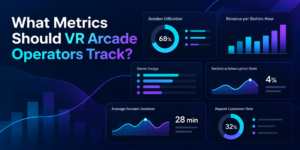
For more on evaluating venue performance, see What Metrics Should VR Arcade Operators Track?.
Use campaign links consistently
If you use Google Analytics, UTM parameters can help identify where campaign visitors came from.
For example, you might use:
utm_campaign=zombie_challenge_nov_2026
Then distinguish channels with parameters such as:
utm_source=instagram&utm_medium=organic_social
or:
utm_source=newsletter&utm_medium=email
Use the same campaign name across channels.
This can help you compare traffic and conversions, although accurate booking attribution also depends on how your website and reservation system are configured.
What Should You Change After the Campaign Ends?
The final day should produce more than a report of likes and impressions.
It should produce a decision.
Compare the campaign with a relevant earlier period, while considering differences in seasonality, operating hours, available capacity, and other promotions.
Then look for patterns.
| What happened? | What to investigate next |
| Many page visits, few bookings | Offer clarity, pricing, availability, or checkout friction |
| Few page visits, strong conversion | Whether the same message could reach more people |
| More bookings, weak profit | Discounts, campaign costs, and pricing |
| Strong bookings and game usage | Extending the campaign or testing a similar title |
| Good first-visit response, few return visits | Post-visit communication and new reasons to return |
| Little response overall | Audience, timing, game selection, or campaign message |
Do not change everything at once.
If the offer converts well but receives little traffic, you may only need better distribution.
If the campaign attracts plenty of visitors but few reservations, increasing advertising spend may not solve the problem.
Start with the weakest part of the customer journey.
Over time, these reviews can help operators understand which audiences respond to particular games, which offers generate bookings, and which channels deserve more attention.
Frequently Asked Questions About VR Arcade Marketing Campaigns
Can a VR arcade build a campaign around an existing game?
Yes. A game does not need to be new to become the focus of a campaign. An existing title can attract attention when operators connect it to a specific audience, group activity, challenge, or booking occasion.
How long should a VR arcade marketing campaign run?
There is no universal duration. A 14-day campaign provides a manageable starting point, but the ideal period depends on your customers’ booking habits, available capacity, seasonality, and campaign objective.
Do VR arcades need paid advertising for every campaign?
No. Operators can begin with their website, existing customer email lists, organic social media, staff recommendations, and in-venue displays. Paid advertising can expand reach when the offer and booking process are working well.
What should VR arcades measure during a campaign?
Prioritize completed bookings, booking conversion rate, featured-game usage, attributable revenue, and campaign cost. Social engagement can provide supporting information, but it should not replace commercial results.
Should every marketing channel use a different message?
No. Keep the main offer consistent while adapting the content format to each channel. A short gameplay video may work on social media, while the booking page needs more practical details about the session.
Turn One Game Into a Repeatable Marketing System
A VR arcade does not need to launch a new game every time it wants to attract customers.
Existing experiences can support new group challenges, themed promotions, weekday offers, and return-visit campaigns.
The opportunity is to connect those ideas to a clear commercial objective.
Choose a game that fits your audience. Give customers a reason to book it. Make the booking process straightforward. Coordinate your marketing channels. Prepare your staff. Then measure what happened.
Once you understand what worked, you can apply the same framework to another title in your library.
One game. One audience. One clear offer. One measurable campaign.
That is how a VR arcade can turn its existing content into a more consistent source of booking opportunities.
Looking for more ways to manage and promote your VR game library? Explore SynthesisVR’s venue management and commercial content licensing platform to see how it supports location-based VR businesses.