
Six players can enter the same virtual environment and still have six disconnected experiences.
One player understands the controls immediately. Two are waiting to join the correct session. Another misses the opening instructions. By the time the full group is ready, the most experienced player has already taken control of the game.
Strong multiplayer VR prevents that separation. It gets the group into the experience quickly, makes each player relevant to the outcome, and gives everyone a clear reason to play again.
For an out-of-home VR venue, the experience begins before the first objective appears. Headset assignment, player pairing, session launch, recovery, and reset all influence whether a multiplayer title works as a commercial attraction.
Good multiplayer begins before gameplay
Guests usually see a simple process: put on the headset and start playing.
The operator may see a much longer sequence. Staff need to assign the correct devices, identify the players, create the session, connect every headset, confirm tracking, choose the game settings, and ensure that everyone reaches the same starting point.
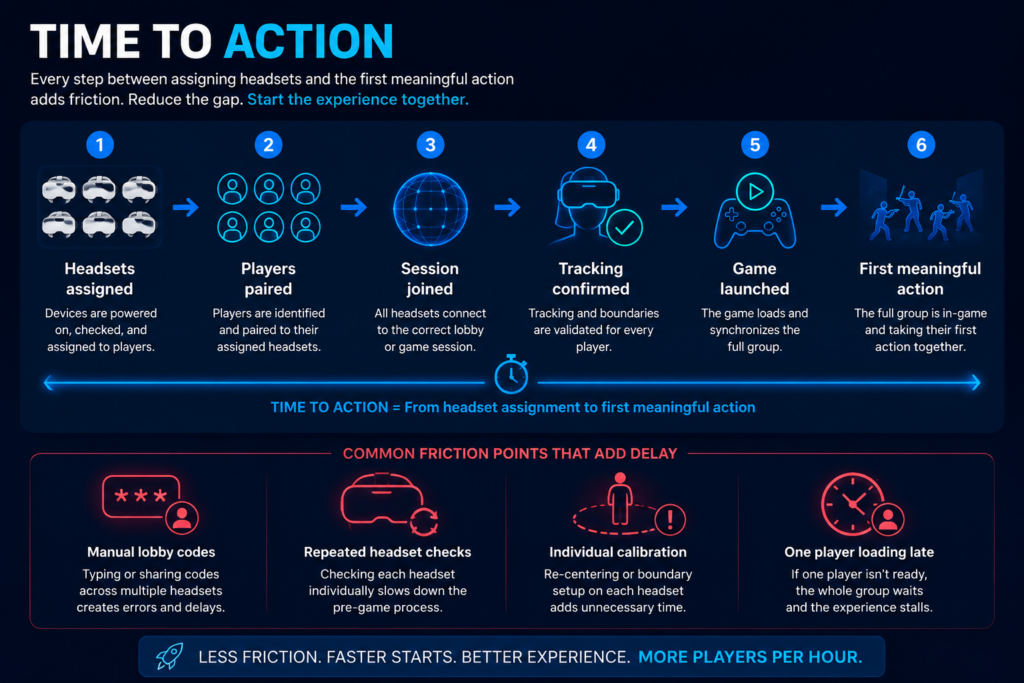
Each additional menu or confirmation adds time. A step that takes only 20 seconds on one headset can create several minutes of delay across a group of six or eight players.
That makes time to action one of the most useful ways to evaluate multiplayer VR for a venue. It measures the interval between assigning the group’s headsets and the moment every player begins meaningful gameplay.
A commercially strong experience keeps that interval short. Players join the correct session easily, staff can confirm that every device has connected, and the full group enters the game together. The process should remain consistent across different employees and successive bookings.
A visually impressive title can still become a difficult venue product when staff spend too much of the session preparing it.
Visual 1 placement: Time to Action
Headsets assigned → Players paired → Session joined → Tracking confirmed → Game launched → First meaningful action
Show common friction points below the flow: manual lobby codes, repeated headset checks, individual calibration, and delayed players.
The group should enter as one unit
Multiplayer sessions lose energy when players begin at different times.
One person may reach the lobby immediately while another remains on a loading screen. A third player may enter the wrong room. Staff then move between headsets, repeat instructions, and delay everyone who connected correctly.
A strong multiplayer workflow treats the group as one operational unit. Each headset should be easy to identify, every player should enter the correct session, and staff should see when the group is ready without checking each device individually.
This becomes particularly important during birthday parties, corporate events, school visits, and back-to-back weekend bookings. One delayed player can affect the timing of the whole group and every booking that follows.
A smooth launch creates confidence. Players begin together, understand that the experience has started, and focus on the activity rather than the equipment.
Room-scale and free-roam require different standards
Room-scale and free-roam VR can both support multiplayer, although they create different relationships between the players, the hardware, and the physical venue.
Room-scale multiplayer
In a room-scale setup, each player normally remains inside an individual station or defined play area. The players connect through a shared virtual session while avatars, voice, objectives, and scoring create the multiplayer experience.
Room-scale VR also exists in consumer environments. For a commercial venue, its value often comes from flexibility. The same stations may support multiplayer games, solo content, escape experiences, and other attraction categories.
That flexibility does not remove the need for a strong operational workflow. Staff still need to connect the correct stations, place every player in the same lobby, launch the session together, and recover an individual device when something goes wrong.
The gameplay must also justify the additional coordination. Players should see, hear, help, challenge, or depend on one another. Several people playing alongside each other with separate objectives may share a server without creating a meaningful group experience.
Free-roam multiplayer
Free-roam changes the connection between the physical venue and the virtual environment.
Players walk through the same real space while seeing a shared virtual world. Their physical position, direction, and movement become part of the group interaction.
Commercial free-roam depends on dedicated floor space, mapped boundaries, coordinated hardware, safety procedures, and operator-managed sessions. These requirements make it specifically an out-of-home format.
The shared arena can create strong social presence, but it also raises the operational standard. Player alignment, tracking, boundary setup, headset assignment, server connection, and session synchronization all need to work together.
A configuration problem on one room-scale station may affect one player. In free-roam, one tracking or alignment issue can delay the entire arena.
The strongest free-roam experiences reduce repeated setup and make the arena behave predictably between sessions. Staff should not need to recalibrate the space, rebuild the lobby, or guide each headset through a separate joining process for every group.
Guests may never see the full configuration process. They still experience every delay it creates.
Visual 2 placement: Room-Scale vs. Free-Roam
A two-column visual showing:
Room-scale: individual stations, shared virtual session, flexible content rotation, station-level recovery.
Free-roam: shared physical arena, coordinated tracking and boundaries, spatial group interaction, group-level operational impact.
Every player should affect the outcome
Shared space alone does not create meaningful multiplayer. Research into collaborative VR describes co-presence, the feeling of being together with another person in the same virtual environment, as a central part of multi-user experience design. The quality of collaboration also changes according to the task, communication methods, and feedback available to players.
The other players need to matter. One person may defend an area while another completes an objective. Teammates might revive one another, solve connected puzzles, share resources, or contribute individual results to a team score.
The structure can remain simple. Players only need to understand how their actions affect the rest of the group.
This matters because commercial venues regularly serve mixed-skill audiences. One booking may include experienced players, first-time headset users, children, parents, and people who rarely play games.
A strong multiplayer title allows the confident player to improve without making the beginner irrelevant. Simpler support roles, clear early objectives, adjustable difficulty, and team-based scoring can help everyone contribute.
When one skilled player completes every task while the rest follow, the group may finish the session without feeling that they achieved something together.
Good multiplayer gives each person enough agency to create a shared memory. Players remember who protected the team, who solved the puzzle, who missed the final shot, or who panicked first when the lights went out.
Fast onboarding protects paid session time
Out-of-home players rarely arrive with detailed knowledge of the title. Some have never used the hardware before. A 2023 review of VR onboarding practices highlighted the importance of instruction availability, corrective feedback, and teaching interactions within meaningful tasks rather than separating every instruction from the experience.
The experience should teach the first essential interaction through action. A player picks up an object, uses it once, sees the result, and moves into the opening objective. Additional weapons, roles, or strategic mechanics can appear after the group starts playing.
This approach gives beginners an immediate point of entry while preserving depth for returning players.
Long explanations create several problems. Players may forget instructions before they need them, confident users lose patience, and staff spend valuable session time repeating information inside individual headsets.
Clear onboarding also helps the group begin from a similar level of understanding. When everyone knows the immediate objective, the social experience starts sooner.
The best opening does not explain everything the player may eventually do. It gives the group enough information to act together.
A clear result creates replayability
A strong ending tells the group what happened.
The result might be a score, completion time, team ranking, survival time, mission outcome, accuracy rating, or unfinished objective. The exact format depends on the experience. What matters is that the players understand the outcome and can imagine changing it.
A visible score creates an immediate comparison. Research into game motivation has linked players’ feelings of competence, autonomy, and connection with enjoyment and intention to play again. Intuitive controls also help players focus on the experience instead of the mechanics.
A completion time invites the group to try again. A failed mission encourages better coordination. A higher difficulty gives experienced players another target.
Replayability can also come from emotion and group behavior. Horror experiences often succeed because players react to both the virtual threat and one another. A guest may return with different friends simply to watch how they respond. Cooperative missions create stories the group discusses afterward. Competitive games encourage rematches because the result belongs to the players rather than only to the game.
The experience does not need scores, alternative endings, difficulty levels, and progression all at once. It needs one clear reason for another round or another visit.
A useful test is to ask:
What could this group do differently or better next time?
When the players can answer that question, the experience has created a replay loop.
Visual 3 placement: The Replayability Loop
Play → Result → Compare → Improve → Replay
Surround the loop with examples such as higher score, faster completion, better teamwork, harder difficulty, and a different outcome.
Fun can take several forms
Multiplayer VR often gets evaluated through excitement and spectacle. Out-of-home audiences respond to a broader range of experiences.
Competition creates energy through rankings and rematches. Cooperation gives the group a shared objective. Horror adds anticipation and social reactions. Physical games reward movement and coordination. Puzzle experiences create satisfaction when the team discovers the solution together.
The emotional promise should remain clear. Guests need to understand whether they are booking something frightening, tactical, chaotic, competitive, or collaborative.
That clarity helps the venue market the title to the right audience. It also reduces the risk that a family group books an intense horror session or an experienced team receives an experience designed mainly for first-time players.
A strong attraction delivers its intended emotion consistently while leaving enough variation for different groups to create their own stories.
Recovery and reset are part of multiplayer quality
Multiplayer reliability becomes most visible when something goes wrong.
Imagine that one headset disconnects halfway through a six-player session. Staff should be able to identify the affected device, reconnect or replace it, and return the player to the experience without rebuilding the full lobby or losing the group’s progress.
The same principle applies when tracking drops, a player exits the application, or one device fails to reach the starting area.
A commercially reliable experience contains the problem. It gives staff a clear recovery path and limits the disruption to the affected player.
A difficult experience turns one device issue into a full-session restart.
Reset time carries equal importance. After the group finishes, the title should return to a predictable ready state. Staff should not need to clear multiple menus, recreate teams, or recalibrate the complete setup before the next booking.
The ideal operating cycle remains easy to understand:
Assign. Connect. Launch. Play. Finish. Reset.
The fewer manual decisions required within that cycle, the easier it becomes to deliver consistent sessions across different staff members and busy periods.
Where the operational platform fits
Multiplayer delivery connects several parts of the venue operation. Staff need to manage commercial content, identify devices, organize players, launch sessions, monitor the headset fleet, and recover from problems.
When those tasks sit across disconnected tools and individual headset menus, employees carry the coordination burden themselves.
SynthesisVR brings content, devices, and session control into one operational layer for commercial VR venues. This helps operators reduce manual steps across room-scale and free-roam setups while keeping the guest experience at the center of the session.
For players, the value appears as a faster and more coordinated start. For staff, it appears as a repeatable process that does not depend on remembering a different launch sequence for every title.
A practical operator scorecard
Operators should test the full commercial session, beginning before the players put on the headsets and ending after the experience resets.
A title may perform exceptionally well inside VR while creating too much setup, recovery, or turnover work around it.
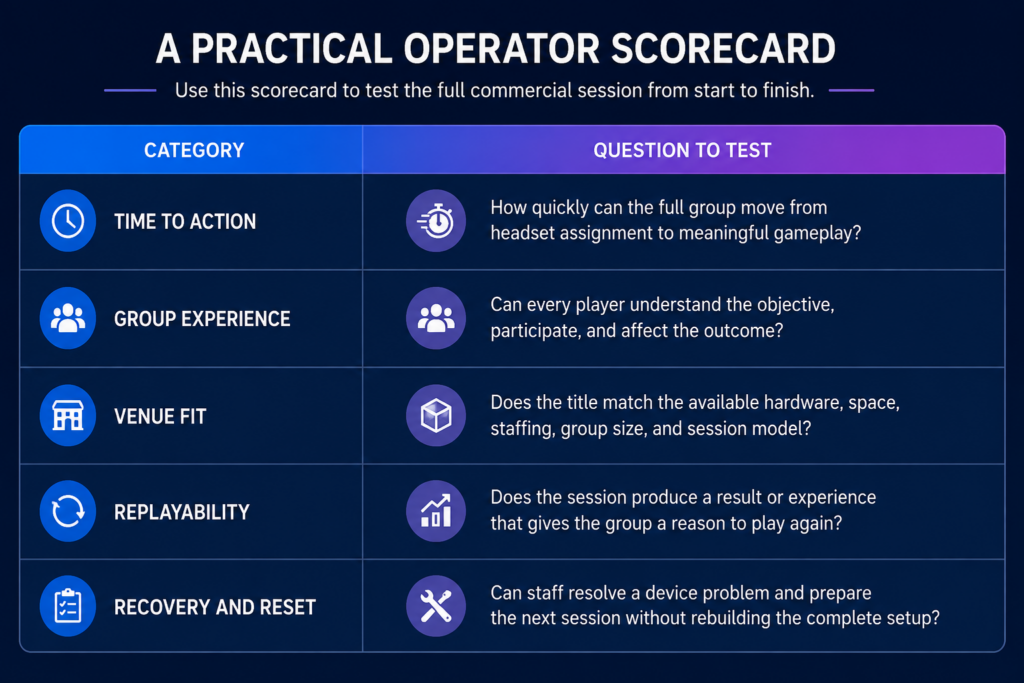
A title does not need a perfect score in every category. A premium free-roam mission may require more preparation than a short room-scale competition. A narrative experience may offer less score-based replay than an arena game.
The experience still needs to deliver enough value to justify the time, space, staffing, and operational complexity it requires.
The strongest experiences work on both sides of the headset
Players remember what happened inside the experience. They remember who scored highest, who solved the final puzzle, who protected the group, and whether the team completed the mission.
Operators experience the same title through configuration steps, launch time, recovery, reset speed, hardware requirements, and staff workload.
A good multiplayer VR experience succeeds on both sides.
It gets the group into action quickly, gives every player a meaningful role, and ends with a clear reason to return. Room-scale titles need to connect players across individual stations. Free-roam experiences need to coordinate a shared arena with minimal friction.
For an out-of-home venue, operational simplicity forms part of the guest experience.