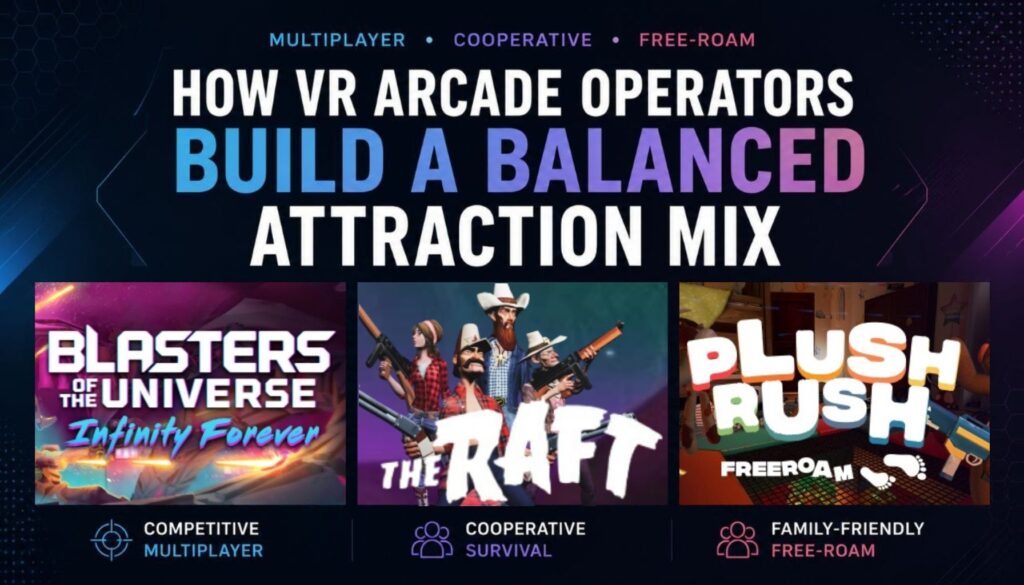
Many VR arcade operators begin with a single attraction category. Over time, most venues expand into multiple experience types to support repeat visits, attract broader audiences, and create more flexible booking opportunities across different customer groups.
Across operator discussions, community polls, and venue feedback gathered through the SynthesisVR ecosystem, several attraction categories consistently appear in conversations around repeat visits, group bookings, and long-term replayability.
Competitive multiplayer attractions often support repeat local traffic and score-chasing behavior. Cooperative adventures help venues broaden group appeal, while approachable free-roam experiences can make VR more accessible to first-time players and mixed-age groups.
Many operators eventually discover that long-term venue growth depends less on finding a single “perfect” attraction and more on building a balanced mix of experiences that support different audiences, session types, and booking behaviors.
This matters even more as location-based entertainment VR continues evolving across PCVR, standalone VR, multiplayer attractions, and free-roam deployments. Operators now evaluate VR attractions not only by visuals or genre, but also by onboarding time, throughput, replayability, spectator visibility, hardware requirements, and long-term operational value.
Why Attraction Mix Is a Business Decision, Not Just a Content Choice
Operators don’t build attraction mixes because they want more variety. They build them because each attraction type solves a different operational and commercial challenge.
The strongest venues use a balanced lineup to:
- support repeat visits
- fill different booking windows
- attract broader audiences
- improve throughput
- increase revenue per square foot
- support premium pricing opportunities
This approach closely mirrors how experienced IAAPA-focused operators evaluate attractions: through throughput, replayability, space efficiency, audience fit, and operational simplicity rather than visuals alone.
Every attraction you add should answer at least one of these questions:
- Does it increase throughput during peak hours?
- Does it improve repeat visitation?
- Does it expand your audience?
- Does it support premium pricing?
- Does it fit your operational reality and staffing model?
A visually impressive attraction can still underperform commercially if it creates bottlenecks, requires difficult resets, or only appeals to a narrow audience segment. At the same time, a simpler competitive multiplayer attraction can outperform financially if it drives repeat play, quick turnover, and strong local traffic.
A Practical Scorecard for Evaluating VR Attractions
Many operators now evaluate attractions using a practical scoring framework before expanding their VR content lineup.
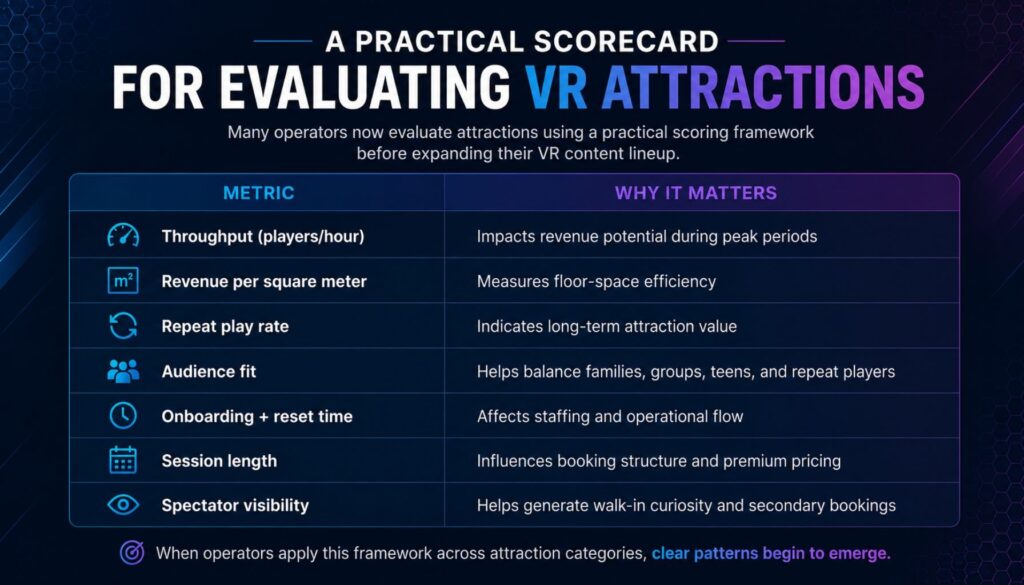
When operators apply this framework across attraction categories, clear patterns begin to emerge.
Accessible Multiplayer Attractions and Family-Friendly Free-Roam
Plush Rush Free Roam
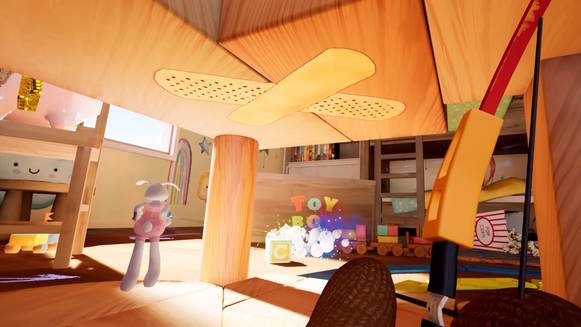
Approachable multiplayer experiences play an important role inside many VR arcades and family entertainment centers. Not every booking comes from competitive players looking for tactical combat or high-intensity gameplay. Many venues also serve mixed-age groups, first-time VR users, birthday parties, and visitors who want a lighter social experience.
Plush Rush Free Roam fits well into this category through cooperative gameplay, approachable visuals, and multiplayer free-roam interaction. The experience supports PCVR free-roam deployments and gives operators an attraction category that feels visually distinct from traditional combat-focused experiences.
Why This Category Matters
Family-friendly free-roam attractions typically score high in:
- audience accessibility
- mixed-age group suitability
- daytime bookings
- birthday party potential
- first-time VR adoption
These experiences can help venues broaden audience reach while reducing intimidation for guests who have never tried VR before. They also complement higher-intensity categories by giving operators more flexibility across different booking types and customer demographics.
Hardware and Deployment Considerations
Plush Rush Free Roam supports PCVR free-roam environments, making it more suitable for venues operating tracked multiplayer arenas or larger room-scale VR spaces.
Operators evaluating free-roam attractions often consider:
- available floor space
- multiplayer synchronization
- headset fleet management
- reset timing between sessions
- spectator flow around the arena
Competitive Multiplayer Attractions and Replay-Focused Sessions
Blasters of the Universe Infinity Forever
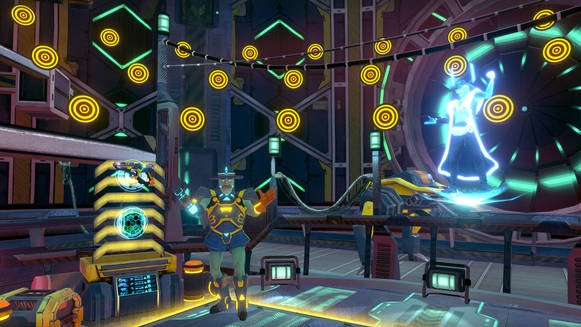
Competitive multiplayer attractions continue performing well inside many VR arcades because they naturally support replayability, repeat visits, and short-session engagement loops.
Arcade-style experiences with score chasing, fast onboarding, and visually active gameplay often encourage “one more round” behavior among returning players and friend groups. These categories also work well in venues that rely on strong session turnover and repeat local traffic.
Blasters of the Universe Infinity Forever represents this category through fast-paced multiplayer gameplay that fits naturally inside arcade-style VR environments.
Why This Category Matters
Replay-focused multiplayer attractions often score highly in:
- repeat visitation
- throughput
- spectator visibility
- fast onboarding
- session turnover efficiency
This category can help operators support:
- weekday traffic
- returning competitive groups
- local repeat visitors
- shorter multiplayer bookings
- arcade-floor energy and visibility
Competitive attractions also perform well from a spectator perspective. Walk-in visitors can quickly understand the gameplay flow, which often increases curiosity and generates additional bookings inside active entertainment venues.
Hardware and Deployment Considerations
Competitive arcade-style attractions can support both dedicated VR arcades and mixed entertainment venues looking to maintain faster session flow throughout the day.
Operators evaluating these categories often focus on:
- onboarding speed
- reset time between groups
- repeat-session behavior
- spectator visibility
- operational throughput
Cooperative Survival and Exploration Experiences
The Raft
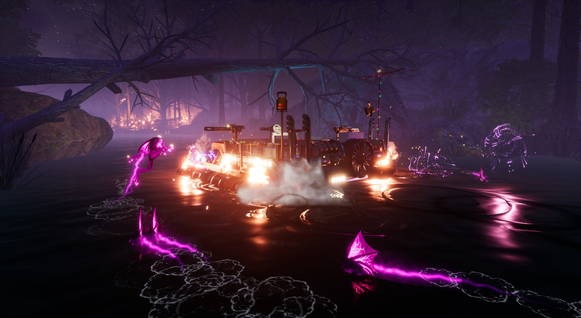
Cooperative survival and exploration experiences occupy a different role inside the LBVR ecosystem. Instead of focusing entirely on competition or high-intensity pacing, these attractions encourage communication, shared progression, exploration, and slower cooperative gameplay.
The Raft fits into this category through teamwork-driven multiplayer sessions that emphasize survival mechanics and group coordination rather than direct player-versus-player competition.
Why This Category Matters
Cooperative survival experiences often score highly in:
- premium group bookings
- immersion
- session depth
- communication-driven gameplay
- group retention
These categories help venues support:
- mixed-skill groups
- cooperative social bookings
- longer-form immersive sessions
- team-oriented gameplay
- attraction diversity beyond competitive formats
Different pacing structures also matter operationally. Some groups prefer fast replay loops, while others want more immersive progression and communication-heavy gameplay. Offering both categories helps venues support broader customer preferences without relying entirely on a single attraction style.
Hardware and Deployment Considerations
Cooperative survival experiences often work well inside PCVR multiplayer environments where immersion, environmental detail, and longer session structures play a larger role in the overall experience.
Operators evaluating these categories frequently consider:
- average session length
- staffing attention requirements
- communication dynamics between players
- space usage
- how longer-form attractions fit alongside shorter arcade-style experiences
Network Veteran Studios and Long-Term Operational Confidence
All three highlighted titles come from Network Veteran studios within the Deploy Reality ecosystem. This designation reflects developers with an established history of commercial VR deployment and long-term operator support across LBVR venues.
For commercial operators, long-term developer support matters alongside gameplay quality. Venues often prioritize:
- operational stability
- ongoing updates
- deployment reliability
- multiplayer support
- long-term compatibility
- commercial deployment history
That becomes increasingly important as venues scale across multiplayer VR, free-roam attractions, PCVR environments, and mixed hardware ecosystems.
Managing different attraction categories across PCVR, standalone VR, multiplayer sessions, and free-roam deployments also becomes more operationally complex as venues grow. Operators using SynthesisVR can organize commercial VR content, manage headset fleets, launch sessions, and support multiple attraction formats through a single VR management software ecosystem built for location-based entertainment VR environments.
Looking to expand your VR arcade attraction mix with multiplayer, free-roam, and cooperative experiences designed for commercial LBVR venues? Explore the SynthesisVR VR content marketplace and discover attraction categories that support repeat visits, broader audience reach, and long-term operational flexibility.