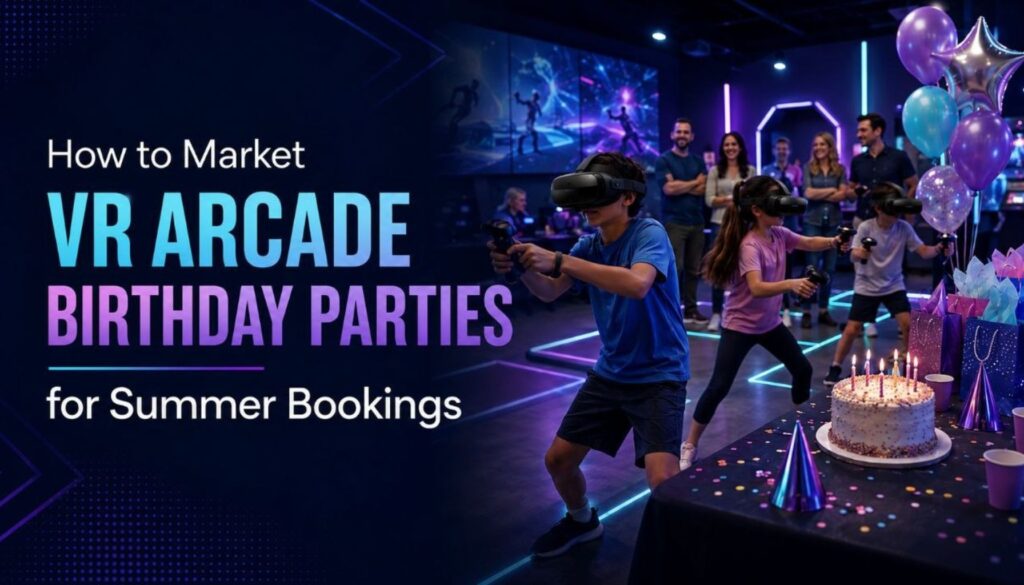
Birthday parties remain one of the clearest packaged revenue opportunities in family entertainment. IAAPA’s 2025 Entertainment Center Benchmark Report tracks revenue generation, attraction mix, guest behavior, staffing, and operational performance across entertainment centers, while IAAPA’s birthday party manual frames party programs as a practical revenue and efficiency opportunity for FEC operators.
The same packaging model shows up across family entertainment categories: trampoline parks, bowling centers, and kids’ entertainment chains usually build parties around a reserved space, a fixed guest count, a clear price, food or drink options, and a defined block of time. Parents choosing where to hold a party are buying clarity and convenience first.
VR arcade birthday parties can use the same structure, with the real operator challenge being how to fit the headset portion inside a larger party flow without creating delays, confusion, or extra work for staff.
What proven birthday party pages already do
Strong birthday pages make the decision easy for parents by showing the package name, the guest count, the time included, what the venue handles, and what happens if extra children arrive.
Across family entertainment, the pattern is consistent: party packages include activity time, a reserved table or room, a host or staff support, food and drinks, and a clear add-on price for extra guests. Public party pages from major entertainment brands show this clearly, from trampoline party packages with jump time, party room time, food, and drinks to family entertainment packages with fixed guest counts and two-hour gameplay windows.
That structure matters because parents compare quickly. A parent planning a birthday party rarely wants to calculate headset capacity, session timing, cleanup time, food rules, and add-on pricing from scratch. They want to know what the party includes, how many children can attend, how long the visit lasts, and what they need to do next.
For VR arcades, this means the party page should sell the full visit, not only the headset session.
Where VR arcades need a different operating model
VR parties work differently from bowling lanes or trampoline floors because the whole group may not play at once: a party of 10 to 12 children does not need 10 to 12 headsets running simultaneously, and many venues run a stronger flow with 4 to 6 stations, short rotations, and a spectator screen while the rest of the group eats, watches, and socializes.
VR arcade birthday parties need more structure than a standard booking. The operator has to manage headset count, content choice, session timing, rotation order, spectator display, safety briefing, and room turnover, and parents feel it when that flow changes depending on who works the Saturday shift.
The birthday package should make the VR portion feel planned from the moment the group walks in, starting with a clear room-and-rotation model.
Build the package around the room, not only the headsets
Start with the party room or reserved area, booking it for a fixed block of time, seating the group for arrival, food, cake, and gifts, then running the VR session as one scheduled segment inside that block.
For larger groups, short rotations work better than seating every child in a headset at once. A 10 to 15 minute rotation keeps the party moving while guests who are not currently playing watch on a screen, eat, or get ready for their turn.
State the total visit length up front, so a parent booking a 90-minute or 120-minute party knows when to arrive, when the VR session starts, when food or cake happens, and when the room turns over. Price the package per participant or by tier, with a minimum group size, and add a fixed extra-child price so staff already know what to say when a family arrives with two additional guests.
Keep the base tier simple and use the mid and upper tiers for higher-margin additions. Food should be easy to handle around VR equipment: wrapped snacks, pizza slices served away from controllers, veggie cups, sliders, or simple drink packages work better than messy options that slow cleanup or leave residue on headsets and controllers.
Example VR birthday package structure
A clear package structure helps parents compare options and helps staff run the same flow every time.
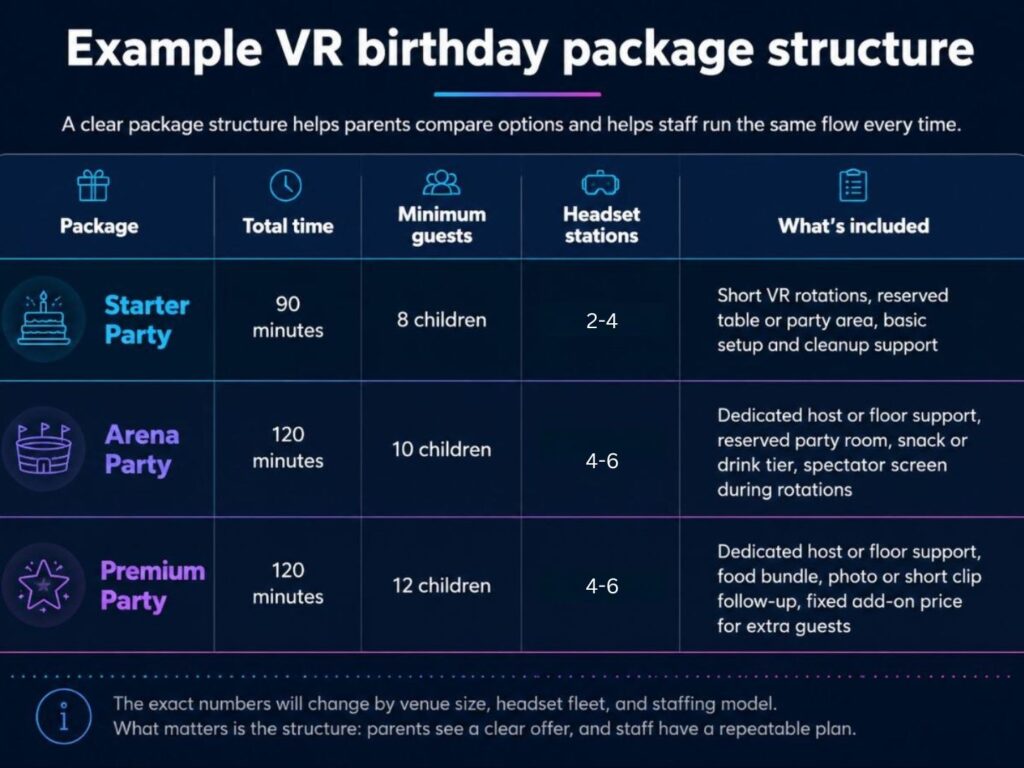
The exact numbers will change by venue size, headset fleet, and staffing model. What matters is the structure: parents see a clear offer, and staff have a repeatable plan.
Make the package easy to find and easy to trust
Give the birthday offer its own landing page, separate from general group bookings. Parents comparing venues in one evening will scan quickly, and a dedicated birthday page signals that parties are a normal part of the business.
Use simple package names a parent can repeat on the phone, such as Arena Party, Squad Party, or Birthday Battle, and add the guest count, time block, price, what is included, and what parents can bring.
Real photos of past birthday sessions answer questions stock images cannot: where children wait, where parents sit, what the room looks like, and whether the venue has actually hosted this type of event before.
Add a short host guide or FAQ covering arrival time, food rules, cake timing, waivers, age limits, what guests should wear, how rotations work, and what happens if the group size changes.
Move routine changes online
Birthday bookings create small changes: parents update the guest count, ask about food, confirm arrival time, add siblings, or ask whether they can bring cake.
A short online form can handle many of these updates before party day, saving staff from repeated phone calls and giving the venue a written record before the group arrives.
Send a confirmation message a few days before the party with the final headcount, arrival window, package tier, food choice, and any waiver instructions, then give staff a one-page checklist for the visit covering room setup, headset count, content selection, rotation schedule, food timing, cake timing, cleanup, and follow-up.
That is group VR experience management in practice: the booking details, headset setup, content choice, and staff checklist all point to the same plan.
Where SynthesisVR fits into the workflow
A birthday package only works when staff can repeat the same flow every time. SynthesisVR gives operators a VR management software and content licensing platform for location-based entertainment, helping venues manage headset stations, launch multiplayer sessions, organize licensed VR content, and run commercial VR experiences from a central operator layer.
For birthday parties, that consistency matters. A 12-child group depends on clear timing, fast session starts, the right content, and a staff workflow that does not change every weekend, and when the VR portion runs smoothly, the room, food, rotations, and follow-up become easier to manage around it.
Follow up after the party
The party should not end when the group leaves: send a short thank-you message after the visit with a photo collage or short clip the parent can share.
That follow-up extends the reach of the booking: one parent post can put the venue in front of other families, school groups, scout groups, and siblings who may need a birthday idea later in the year.
Ask for a review while the experience is still fresh, keeping the request simple and tied to the party itself: was the booking easy, did staff help the group, did the children enjoy the session.
Birthday parties can become more than weekend revenue if the follow-up works, introducing the venue to families who return later for school breaks, after-school sessions, friend outings, and future celebrations.
Key takeaways for operators
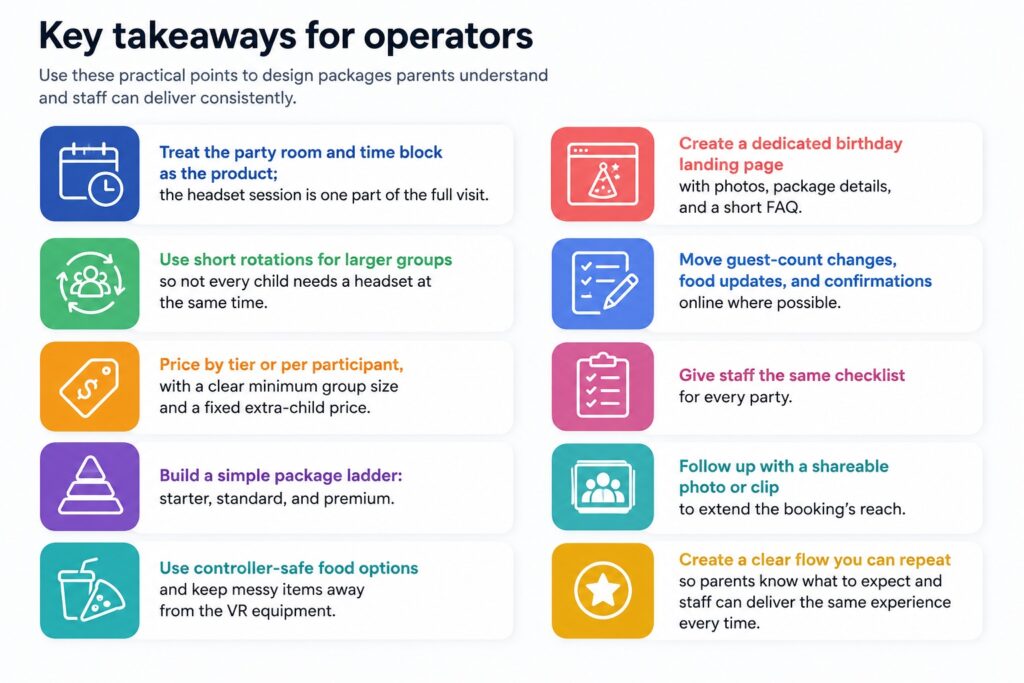
A structured party package works because it turns a high-touch group booking into a repeatable operating model. For VR arcades, that means the party room, headset rotations, licensed content, and staff workflow all need to support the same customer promise.
See how SynthesisVR helps VR arcade operators manage multiplayer sessions, licensed VR content, and repeatable group booking workflows.
Related Reading
What Entertainment Venues Should Know Before Adding VR Attractions
How VR Entertainment Centers Attract Student Groups and Young Adult Audiences
Why Multiplayer VR Attractions Drive Repeat Visits and Higher Utilization