By the end of August, a VR venue’s guest list is usually the longest it will be all year. First-time bookings come in from tourists and from families killing a rainy afternoon. Some walk in on a whim after seeing a friend’s video. A single follow-up email or a discount code in September won’t turn that list into a customer base. Most of it has already forgotten the visit by then.
A first-time guest hasn’t paid for themselves yet, not in any real sense. Getting them through the door costs something: an ad, a discount, a slow afternoon spent chatting them up at the front desk. That cost lands whether they ever come back or not. A guest who visits four times splits it four ways. One who visits once never splits it at all. Repeat behavior isn’t a nice outcome sitting on top of a good season. It’s where a first visit actually turns into a return on what it took to earn it.
How VR Arcades Transition From Summer Traffic to Local Repeat Visitors covered the first half of this problem. Sort visitors at booking. Sell the second visit before the guest leaves the building. Build a monthly reason to come back. That gets a first-timer to book again once. It doesn’t explain what happens next, and next is where most venues quietly stop.
Sort guests before you decide what to tell any of them
A tourist, a birthday parent, and a local teenager who came in with friends are not the same guest wearing different clothes. Send all three the same “come back soon” message, and you waste it on at least two of them.
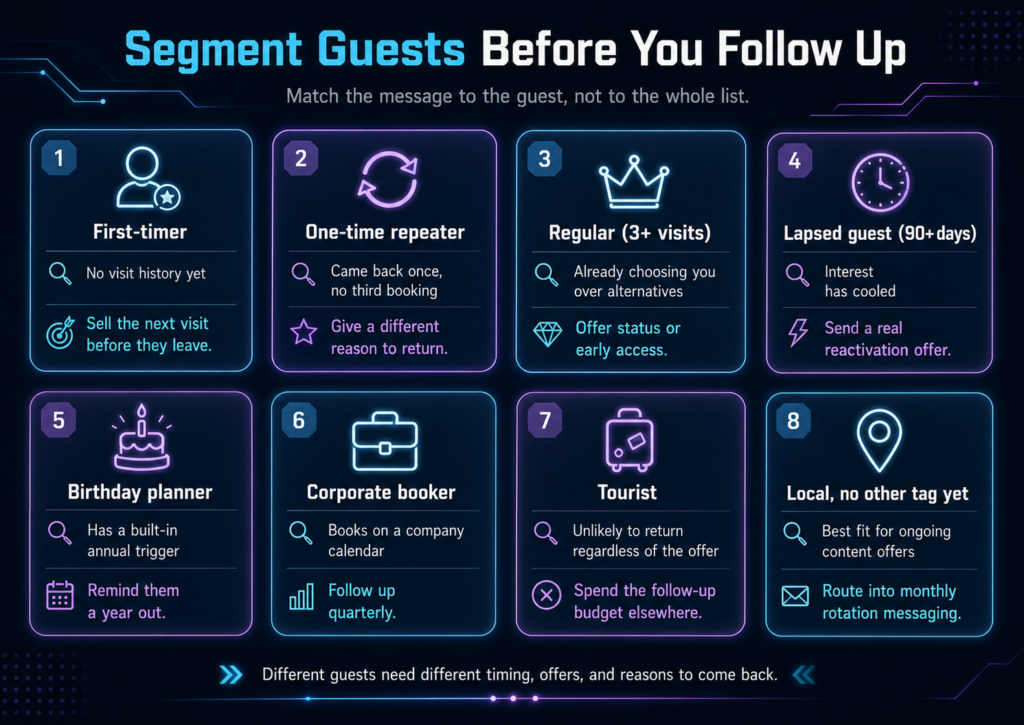
None of this needs a marketing department. It needs a booking system that tags visit history, booking source, and what a guest actually played. Then the next message can speak to who they are, instead of the same one going out to everyone.
The third visit decides whether it’s a habit or a coincidence
What separates visit one from visit two is usually the offer: a discount, an invitation, a reason stated clearly enough to act on. What separates visit two from visit three is whether anything actually changed.
Picture a guest’s second visit looking identical to their first: same headset, same game, same layout. They quietly file the venue under “done that.” They stop opening the next email. Content rotation is what decides whether a second visit turns into a third. A returning guest needs the second experience to feel different from the first. A rotating multiplayer lineup is the cheapest way to create that difference. It doesn’t require buying anything new.
Content is what makes the second and third visit feel different
Every operator agrees content should rotate. Fewer actually run it as a schedule with a name attached.
A cadence that holds up in practice looks simple. One featured multiplayer title changes every month. Staff get a briefing and a new promo photo goes up before the swap. Every quarter, someone reviews the full catalog and checks what guests are actually replaying against what’s gathering dust. Seasonal and holiday-tied content, a Halloween tournament, a school-break event, a leaderboard reset, gives locals a reason to plan a visit around a date. That beats waiting for one more generic reminder. Without someone responsible for making the swap happen on a fixed date, “we rotate content” stays a good intention. It quietly reverts to whatever has been running since June.
Follow-up has to match where each guest actually is
Selling the second visit at checkout gets the first repeat booking. Keeping that guest past visit two takes follow-up timed to the individual, not to a shared send date.
A guest who hasn’t rebooked thirty days after their last visit needs a different message than one who hasn’t rebooked in ninety. At thirty days, a simple nudge tied to whatever’s new that month usually works, because the visit is still fresh in their mind. At sixty, that guest needs a stronger reason: a themed event, a new season, something worth the trip back. By ninety days without a return visit, most guests have effectively lapsed. They belong on a separate, less frequent list, not the regular monthly send. Send a single “come back soon” campaign to the whole list, and it’s just a broadcast. A system responds to each guest’s own clock instead.
Status and perks work harder than another discount code
Regulars stop responding to the offer that got them in the door the first time. What still moves them is proof that you remember they’ve been in before. That can mean early access to a new multiplayer title before it goes live for everyone else. It can mean priority booking during a busy weekend slot. It can mean a leaderboard rank that carries over between visits.
None of this requires a formal membership program. It requires remembering, visibly, that a guest has been in before, and giving them something a first-timer doesn’t get. That’s what keeps a third or fourth visit from feeling like the same transaction on repeat.
A guest’s own clip sells the next visit better than your marketing does
VR is one of the few attractions where the experience is genuinely worth filming. Picture a group failing a co-op mission, or a losing team taking heckles from whoever’s watching the spectator screen. That footage brings a friend group back with new people faster than any paid ad.
Prompting it costs nothing. Position the spectator screen where it’s easy to film. Have a staff member offer to record the last thirty seconds of a session. Add a simple “bring a friend” offer for whoever books off someone else’s visit. Referrals and shared clips grow the guest list without adding to the acquisition cost this whole piece is trying to avoid.
Local repeat guests carry the entire calendar once summer ends
A repeat rate that feels like a bonus on top of steady July tourist traffic becomes something else entirely once that tourist traffic disappears in autumn. It starts to look like the entire demand curve. The same percentage of returning guests means something very different when there’s nothing else filling the calendar around it.
That’s the real reason local repeat guests stop being a growth tactic and become the business itself once the season turns. A venue that spent August only chasing door count walks into autumn with a problem. It has no list, no segmentation, no rotation, and no follow-up timing built to match. That means acquiring nearly all of its traffic from scratch, at exactly the point in the year when new local traffic is hardest to find.
The numbers that actually tell you whether it’s working
Repeat visits are a system, not a campaign. A system needs checking on a schedule of its own, not a glance at total bookings once a month. The number worth starting with is repeat visit rate: returning guests divided by total guests over a set period. On its own, it only tells you whether people came back. It doesn’t say why, how fast, or whether it’s building toward anything.
Time to second visit says more. A first-timer who rebooks in three weeks is behaving very differently from one who takes four months. A venue that only checks whether someone eventually returned misses that difference between a guest forming a habit and one drifting back by accident. Visit frequency per guest over a rolling twelve months separates a real regular from someone who just happens to repeat now and then. That’s the number that should decide who actually gets the regular treatment. Lapsed guest reactivation rate matters too: the share of inactive guests who respond to a real win-back offer, rather than confirm they’re gone for good. That number tells you whether the ninety-day list is worth the effort, or just a record of people who’ve moved on.
Content and follow-up have their own numbers to watch
Content earns its own number: replay rate by title, which experiences guests actually choose again versus which ones they play once and never touch again. That’s a better guide to next month’s rotation than whichever title is newest.
Follow-up needs the same scrutiny. Open rate on a message says almost nothing. Rebook rate off each specific message says whether it actually worked. Track that alongside redemption rate on birthday or event offers, and referral rate: how many bookings arrive because an existing guest brought someone new. A message people open but never book from isn’t working, whatever the open rate says.
Add one softer read alongside all of this: guest satisfaction right after the visit. A one-line “would you recommend this” question at checkout works. So does a quick follow-up text. In a venue that runs on groups and social experiences, word of mouth is already doing real acquisition work. It starts with whether the last group through the door would actually say something good about it.
If a venue tracks only one category to start, make it guest behavior. It’s the clearest read on whether the segmentation, the rotation, the follow-up timing, and the loyalty and referral work in this piece are actually moving anything.
That habit of reviewing the numbers together is what separates two kinds of venues. One got lucky with a strong August. The other is still full in November, for reasons it can actually explain.
Where SynthesisVR fits
Running this well means knowing which guest is on their second visit and which is on their fifth. It means knowing what they played last time, and which multiplayer title is due to rotate in before the next one walks through the door. SynthesisVR gives operators one place to manage that content library, launch sessions, and rotate experiences across every headset in the building. The system behind repeat visits runs on schedule, instead of depending on someone remembering to update it.
Related Reading
Why Multiplayer VR Attractions Drive Repeat Visits and Higher Utilization
How VR Entertainment Centers Market After-School and Autumn Group Activities
How VR Arcade Operators Build a Balanced Attraction Mix