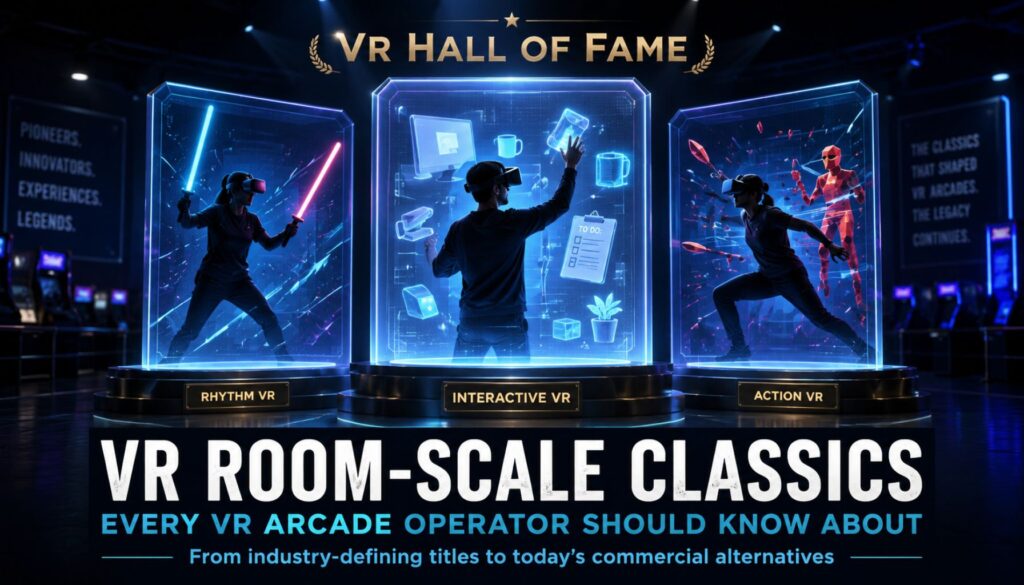
Players researching VR venues often arrive with a shortlist already in mind.These titles introduced millions of people to virtual reality and remain some of the most recognisable names in the medium. For operators building out a commercial venue, that recognition carries real weight: guests arrive already knowing these names, which shortens the conversation at the front desk considerably.
The practical question is whether popularity and commercial availability still line up. For room-scale VR attractions, the answer varies by title, and it matters more than most operators expect when they start evaluating content.
The Usual Suspects
Every operator researching room-scale VR eventually runs into the same names.
Beat Saber. Job Simulator. Superhot VR.
These titles introduced millions of players to virtual reality and remain among the most recognizable experiences the industry has ever produced. For commercial operators, that recognition still carries weight. Guests often arrive already familiar with these games, making them natural starting points when discussing VR attractions.
The practical question, however, is whether recognition and commercial availability still go hand in hand. For room-scale venues, the answer varies considerably from title to title, and understanding those differences can save operators a great deal of time when evaluating content for their attraction lineup.
Beat Saber: The Rhythm Standard That Shaped Commercial VR
Why it still comes up
Beat Saber launched in 2018 and quickly became the benchmark for accessible VR gameplay. The core loop is simple enough to grasp in seconds: swing virtual sabers to slice color-coded blocks in time with music. First-time VR users could pick it up without prior gaming experience. Spectators understood it from across the room.
That combination of spectator clarity and minimal onboarding made it one of the most effective room-scale attractions available during the early years of location-based VR. Guests who watched someone else play often booked a session immediately. The word-of-mouth effect was measurable at floor level.
Where things stand for operators
Meta acquired Beat Games, the studio behind Beat Saber, in late 2019. Following that acquisition, the title was pulled from the commercial arcade licensing ecosystem. The commercial licensing page went offline in June 2020, and arcades were advised to stop activating new stations by July 1 and to remove the game entirely by July 31 of that year.
For operators evaluating content today, this means a title with strong consumer recognition has been unavailable for commercial VR deployment for several years. The guest recognition is real. The licensing route is closed. This is the most common licensing blind spot operators encounter when building out a room-scale content library: a title can remain culturally visible and frequently requested while being completely unavailable for commercial deployment.
Commercial alternative: Synth Riders
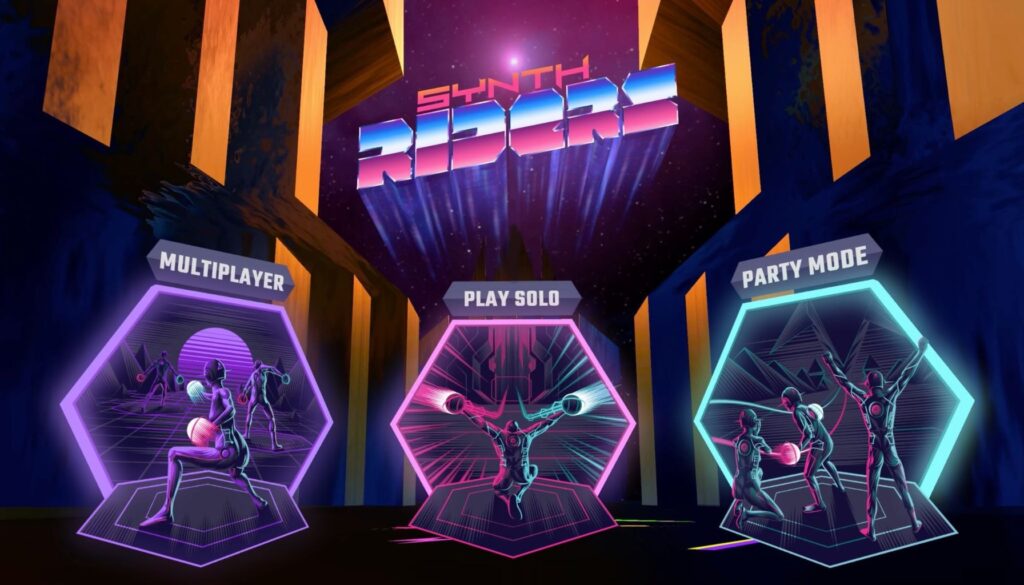
Operators looking for a commercially licensed rhythm game for their VR arcade often look at Synth Riders. The gameplay centers on freestyle movement to music rather than strict note-matching, which tends to produce more varied play styles and different kinds of spectator moments. The game supports up to 10 players in cross-platform multiplayer, includes 46 songs across multiple genres, and carries a local leaderboard mode suited to arcade environments.
It was named a Game of the Year finalist at the VR Awards and featured in Forbes’ Top 50 VR Games of 2019. For operators, the spectator value that made rhythm games commercially effective translates directly: guests waiting nearby can understand what is happening on screen and want to try it themselves.
The commercial license is available through SynthesisVR. View Synth Riders on SynthesisVR.
Job Simulator: The Accessibility Benchmark
Why it still gets requested
Job Simulator launched alongside the HTC Vive in 2016 and became one of the most widely cited examples of successful VR onboarding. Players interact with everyday objects in simulated workplace environments: make coffee, answer phones, flip burgers. Nothing in the experience requires gaming familiarity. The humor lands across age groups, and children in particular respond to the low-stakes experimentation it encourages.
For venue operators, it solved a specific problem: what do you put in front of a guest who has never worn a headset and has no frame of reference for what VR is? Job Simulator answered that question reliably for years across VR arcades and family entertainment centers worldwide.
Where things stand for operators
Job Simulator was available through commercial VR content platforms for a number of years after launch. It has since been removed from commercial licensing and is no longer available for deployment at VR arcades or location-based entertainment venues. Guests, particularly younger visitors and families, still request it by name. Operators evaluating room-scale content for those audiences will need to look at what is currently licensable.
Commercial alternative: Clash of Chefs VR
Clash of Chefs VR is a cooking competition game where players prepare meals against the clock, either in solo mode or against other players in online multiplayer. The physical interactions map to everyday kitchen tasks, which means very little explanation is needed before a session starts. The game was designed without teleportation or in-game movement, which removes one of the most common sources of motion discomfort for first-time VR users.
The competitive multiplayer format adds a group booking angle that purely single-player experiences cannot offer: two guests competing in the same session, or players trying to beat a leaderboard score set by a previous group. For venues serving families, school groups, and social bookings, that dynamic extends the commercial usefulness of a single title across different session types.
The commercial license is available through SynthesisVR. View Clash of Chefs VR on SynthesisVR.
SUPERHOT VR: The Arcade Edition Built for Venues
Why the mechanic still works
SUPERHOT VR launched in 2017 with a premise that has held up unusually well: time moves only when you move. In a medium where players are still calibrating spatial awareness and physical confidence, that mechanic removed a critical source of anxiety. Players could pause, assess, and act on their own terms rather than reacting to a constant stream of incoming threats.
The result was one of the most demonstrable experiences in room-scale VR. Operators could show a hesitant guest ten seconds of someone else playing and communicate the entire concept without explanation. The slow-motion sequences generated compelling spectator moments, which fed directly into social sharing and repeat visits.
The title won the SXSW Gamer’s Voice Award in 2018, IGN’s Best VR Experience in 2017, the GDCA Best VR/AR Game in 2018, and the New York Game Awards Best Virtual Reality Game in 2017.
The Arcade Edition is designed for venues
Unlike most titles developed for the consumer market, SUPERHOT VR has a version built specifically for location-based entertainment operators. SUPERHOT VR: Arcade Edition adds a set of operator-facing features that address the practical realities of running a public-facing VR attraction:
- Configurable session lengths of 5, 15, or 30 minutes, with custom options available
- Local leaderboards and a Hall of Fame display that supports repeat visitor engagement
- An Administrator Panel for adjusting modes and settings without disrupting the guest experience
- A dedicated spectator screen output for waiting guests and bystanders
- Attract Mode to draw attention to an idle station on the floor
- Operator controls to skip levels or reset sessions mid-play if needed
- Mature and sensitive content removed for general audiences
- Language support across 11 languages
That last point matters for venues serving diverse or international markets. The content adjustments and language coverage were built for commercial deployment, not retrofitted from a consumer version. That distinction affects how reliably the title performs across different guest demographics.
The commercial license is available through SynthesisVR. View SUPERHOT VR: Arcade Edition on SynthesisVR.
What These Three Titles Tell Operators
The commercial VR content landscape does not always mirror consumer awareness. Guests request games by name because they have seen them online or tried them at home. The operator’s job is to understand which of those titles are actually available for commercial deployment, which have moved out of reach, and what the functional alternatives look like.
Beat Saber demonstrated that accessible mechanics combined with spectator visibility drive floor-level engagement. Job Simulator showed that interaction density and low onboarding friction reach audiences who would not describe themselves as gamers. SUPERHOT VR proved that a genuinely novel mechanic can stay fresh across years of repeat sessions.
Those lessons transfer to the titles operators can actually license today. When evaluating any new content for a room-scale VR venue, the question worth asking is not just whether a title is well-known, but whether it delivers the same operational value: fast onboarding, spectator appeal, replayability, and a commercial license that holds.
SynthesisVR’s content marketplace carries titles built for LBE operators, with commercial licensing available through a single platform. If you are evaluating room-scale content for your venue, browse the full catalog or get in touch with the team to discuss your setup.