Building an educational VR program for schools takes more than adding educational content to a headset fleet.
Teachers need to understand what students will learn, which ages the activity suits, how a full class will move through the experience, how long the visit will take, and what the school will pay. Libraries, museums, science centers, and other institutions face many of the same questions when adding VR to their educational programming.
For VR arcades and location-based entertainment venues, school groups can also create a new use for weekday capacity. Operators already have much of the infrastructure in place: headsets, staff, commercial VR content, and experience managing groups. The next step is turning those resources into a program that a teacher or institution can confidently book.
Building a program a teacher can approve
Established field trip providers make practical information easy to find. Teachers usually need the age or grade range, learning focus, program duration, group capacity, supervision requirements, accessibility information, arrival instructions, and price before they can move a trip forward.
An educational VR offer needs the same clarity.
A page that simply says “Educational VR available for school groups” still leaves most of the planning with the teacher. A stronger offer explains what students will explore, how the experience connects to a subject, how many students can attend, how the class moves through the available headsets, and what happens during the rest of the visit.
A simple way to plan the offer is to work backward from the questions the school needs answered:
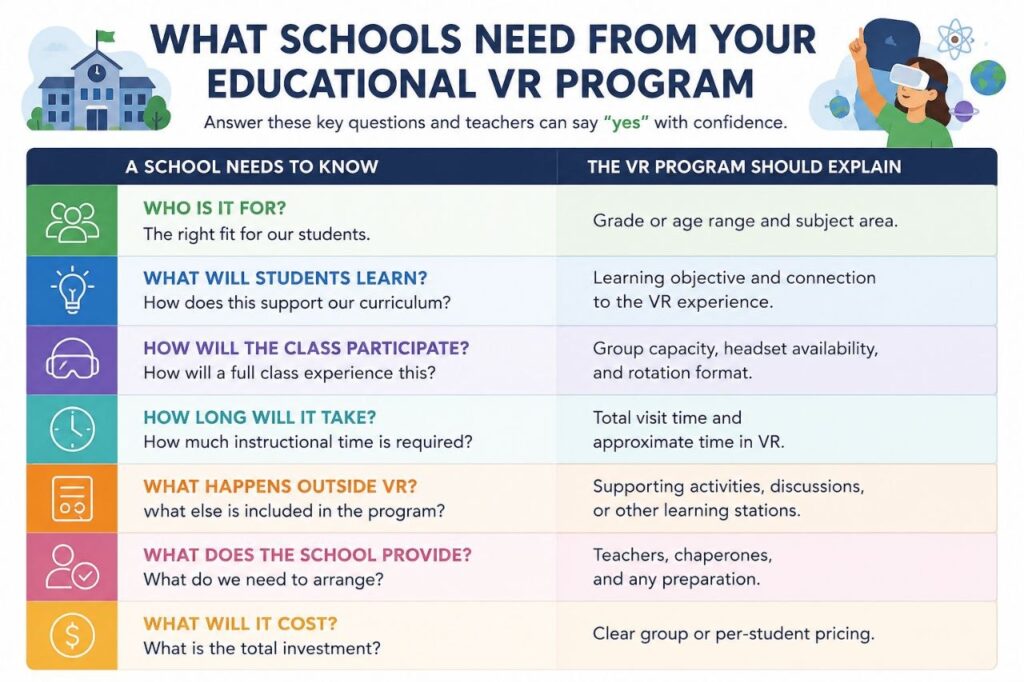
This also changes how an operator chooses educational VR content.
Instead of starting with a list of available experiences, start with the school use case. A biology experience might support a science visit. A virtual field trip could connect with geography or history. Engineering content may fit a STEM program.
The content has a clearer role once there is a program around it.
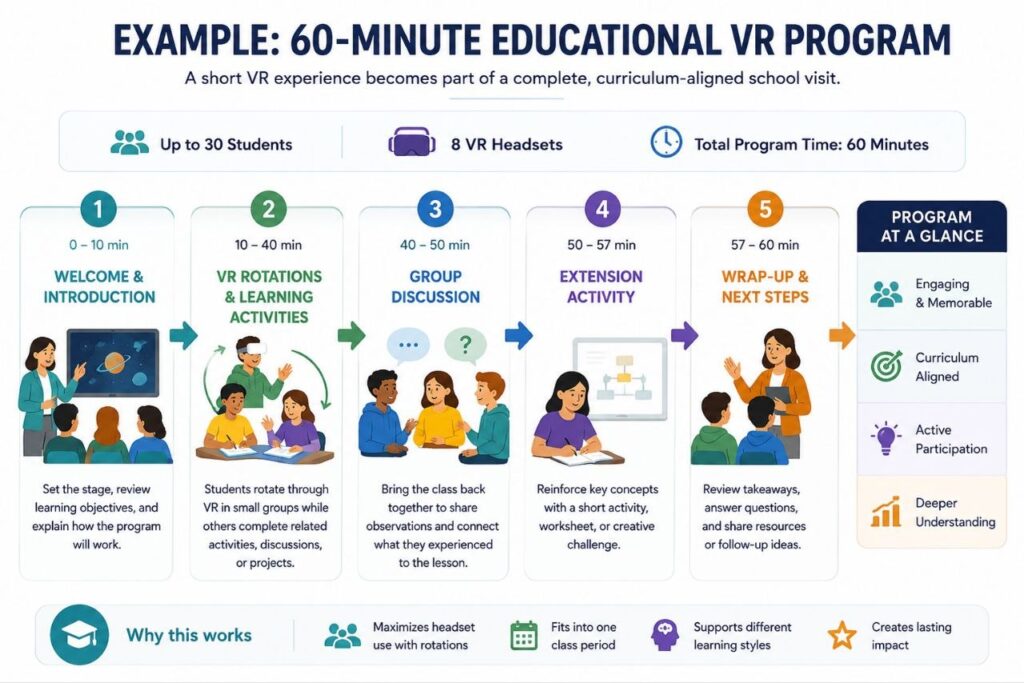
A short VR experience can support a full school visit
The VR portion does not need to fill the entire booking.
During our recent Step Into Webb education webinar, Adventure Portal demonstrated how a relatively short immersive experience can sit inside a longer structured lesson. Step Into Webb itself runs for around 15 minutes and targets students in grades 6 through 10. The wider program can combine that VR session with supporting tasks and teacher-led activities.
For a venue, that creates the possibility of a 45- or 60-minute school visit without keeping every student inside VR for the full hour.
A class might begin together with an introduction to the subject. Smaller groups then move through the VR experience while other students work on related activities. The groups rotate until everyone has completed the immersive portion, then come together again for a discussion or recap.
Supporting activities give the visit more structure and help connect what students see inside VR with the wider learning objective.
This becomes especially useful when the immersive experience itself lasts 10 or 15 minutes. The venue can build a much richer educational program around that time rather than stretching the VR session simply to fill an hour.
Class capacity is bigger than headset count
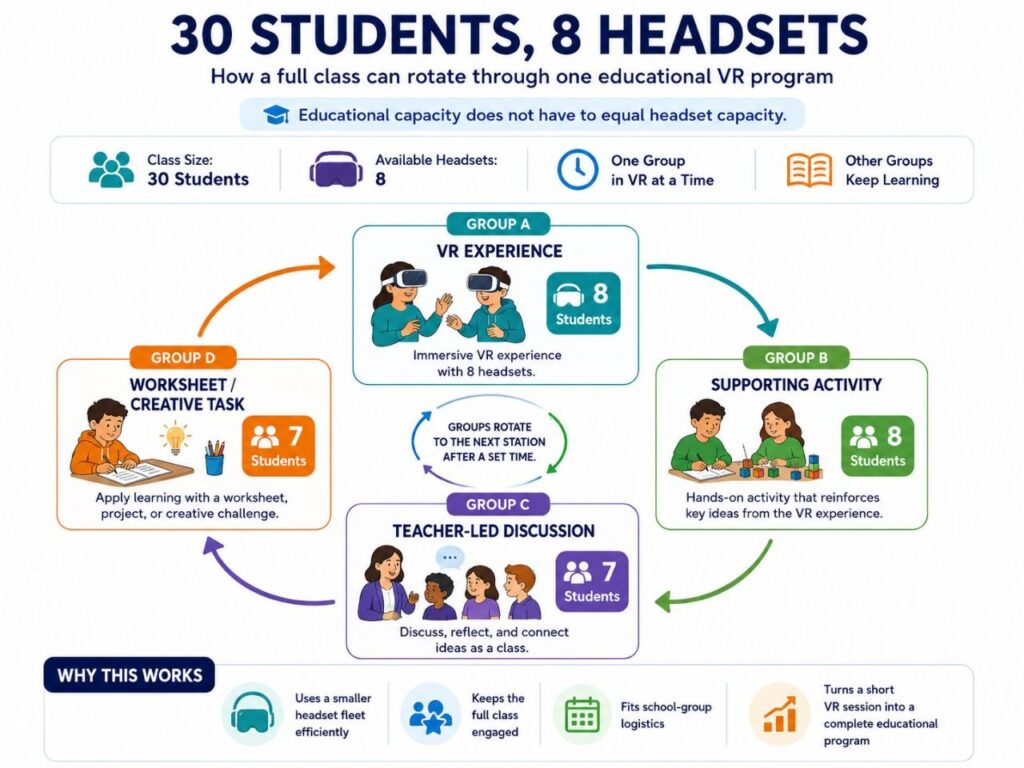
One of the first questions operators often ask is how a venue with six or eight headsets can host a full class.
The answer is in the program design.
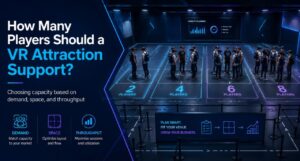
During the Step Into Webb webinar, one example used a class of 30 students and eight available headsets. The class could split into smaller groups. One group enters VR while the other students complete related activities, then the groups rotate.
The exact numbers will differ from one location to another. Available space, staff, student age, experience length, and headset capacity all influence the final setup.
Still, the example highlights an important distinction:
Educational capacity does not have to equal headset capacity.
An operator should calculate how many students can complete the entire program during the available booking window, rather than using the number of headsets as the maximum class size.
This can make educational VR practical for venues that would never consider buying enough hardware for an entire school class to enter VR simultaneously.
Using existing weekday capacity
For an established VR arcade, school visits can fit into a very different part of the weekly schedule from regular entertainment bookings.
A class arriving on Tuesday morning does not compete directly with the birthday parties, friend groups, or free-roam sessions that drive weekend and evening demand.
The venue also already has much of the infrastructure required to deliver the program. Staff understand headset setup and cleaning. The venue has group onboarding procedures, commercial VR hardware, content, physical space, and a VR management system supporting the headset fleet.
Education gives those existing resources another commercial use.
During our education webinar, one operator described running regular field trips and having hosted several school groups within a single day. Their existing program combines educational activities with VR and uses different areas of the venue to move students through the visit.
That example shows why the operational design matters as much as the content.
Staff need to know when each rotation starts, where students wait, which headsets are ready, how long each activity lasts, and who supervises each part of the group. Once the venue establishes that workflow, the next school visit becomes much easier to run.
Educational VR inside schools
Schools and universities can also operate VR directly.
A school with its own headset fleet has a different set of priorities from an entertainment venue. The institution may want one set of hardware to serve several classes, teachers, and subjects throughout the academic year.
A biology class might use the headsets for anatomy or natural science. Another teacher could use the same fleet for engineering, Earth science, history, or a virtual field trip later in the term.
The educational value of the hardware grows when the institution can reuse it across different subjects and age groups.
Content breadth therefore becomes an important planning question. A school investing in VR may get more long-term use from a collection of curriculum-focused experiences than from building the program around one standalone title.
Predictable licensing also matters. Schools often plan budgets across a term or academic year, so knowing how content costs scale across the headset fleet can make the program easier to approve and maintain.
Libraries, museums, and other institutions
Educational VR does not have to sit inside either a school or an arcade.
Libraries can use immersive experiences for STEM programs, virtual field trips, youth activities, geography sessions, or recurring family learning events.
Museums and science centers can connect VR to subjects they already present. A biology experience could extend a natural history program. A science center could add immersive content to a school-group rotation. A museum could use a virtual environment to explore a location or period that cannot be reproduced physically inside the exhibition.
These institutions can build their own VR setup, but they can also work with an experienced local VR operator.
That partnership model gives both sides another option. The museum, library, or educational organization brings the audience and learning context. The operator can provide hardware, setup experience, commercial content, and staff support.
For an institution testing immersive programming, that can reduce the amount of technology it needs to purchase and manage at the beginning.
For a VR operator, it creates another use for equipment and expertise that already exist.
Pricing the complete school program
School-facing pricing should describe the program the teacher is buying.
A breakdown based on individual headset minutes, separate activities, and software charges can make a straightforward field trip difficult to understand.
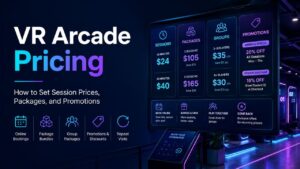
A clearer offer might describe a 60-minute educational program for a class of up to 30 students, including VR rotations, related learning activities, venue support, and any teacher materials available for the experience. The venue can then present one group price or a simple per-student rate.
There is no universal price that works for every location.
Program length, local market conditions, staffing, class size, licensing, and the amount of support included all influence the economics. A short field trip during a quiet weekday period will also have a different commercial profile from a longer workshop requiring several staff members.
The useful principle is predictability.
A teacher should be able to understand what the school will receive and what the expected total cost will be without calculating the price from several separate components.
Choosing educational content and licensing
Once the structure of the program is clear, the venue or institution can choose content and licensing around how it plans to use it.
An operator testing one educational experience has different requirements from a school running a shared VR lab throughout the week. A museum building one recurring exhibit also has different needs from an arcade offering several different school programs.
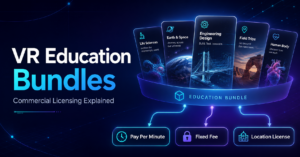
SynthesisVR supports multiple commercial licensing models for eligible content, including Fixed Station Fee and Fixed Location Fee options. The appropriate model depends on the publisher, number of stations, and intended use.
Education bundles provide another route for operators and institutions that want broader access to content. Current SynthesisVR offerings include education-focused collections and curriculum packages covering areas such as middle school, high school, science, dissection, and virtual field trips.
Operators can review the current educational VR bundles and commercial licensing options when deciding which structure fits their program.
Three questions are particularly useful at this stage: how many stations will use the content, how frequently the program will run, and how much curriculum variety the venue or institution wants to offer.
Predictable content costs also make it easier to price the final school program and understand how much each booking needs to generate.
Reaching teachers and schools
The outreach process can vary significantly between school systems, so local research should come before a large email campaign.
During our education webinar, one operator explained that its local public school board prohibits direct solicitation by phone or email. Becoming an approved vendor helped with the administrative side, but it did not automatically put the venue in front of teachers choosing field trips.
That experience shows why operators need to understand how schools in their area actually discover and approve external programs.
Existing customers can be a useful starting point. Parents and teachers who already know the venue may be able to make introductions. Homeschool groups, private schools, STEM departments, parent organizations, libraries, and other education networks can create additional routes into the local school community.
Teacher preview sessions are another practical option.
Instead of asking a teacher to recommend an unfamiliar VR program from a brochure, invite educators to experience it. They can see the content, understand how the class rotations work, ask questions about age suitability, and decide how the program could connect with their students.
That gives the eventual school conversation much more context.
What a school booking page needs to answer
Once a teacher finds the educational VR program, the booking page should remove uncertainty rather than create another round of questions.
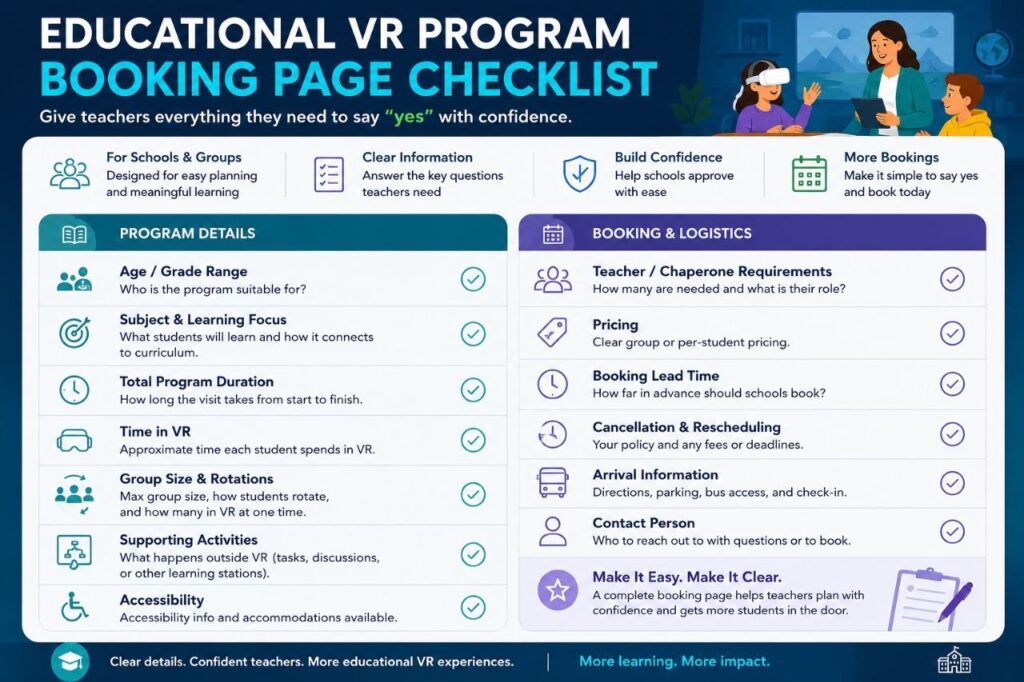
The page should make the suitable age or grade range clear and explain the subject or learning focus. It should state the total duration of the visit, approximate VR time, maximum group size, and how the rotation model works.
Teachers should also be able to find information about supervision, accessibility, supporting activities, pricing, booking lead time, cancellations, and arrival logistics.
If buses regularly bring school groups to the venue, parking and drop-off information can matter just as much as the VR specifications.
A clear contact person is useful too. School trips often involve questions that do not appear in a normal consumer booking, so giving the organizer one person or contact route reduces friction.
Where SynthesisVR fits
SynthesisVR works with VR attraction operators as well as schools and other educational institutions building commercial VR programs.
For an arcade or location-based entertainment venue, educational content can expand the existing operation into school field trips, weekday group bookings, and partnerships with local organizations.
Schools, universities, libraries, museums, and science centers can also use SynthesisVR for dedicated institutional installations.
The SynthesisVR VR content marketplace includes individual educational experiences alongside curriculum and education bundles. Commercial licensing options give operators and institutions flexibility when planning how many stations will use the content and how frequently it will run.
The broader VR management software layer also allows an existing operator to introduce education without building a completely separate operational system for the headset fleet.
One venue may host school groups each Wednesday morning. A school may use the same headsets across several subjects. A library may run a monthly immersive learning program. A museum may add VR to an existing educational exhibit.
The underlying technology may be similar. The program around it determines the audience, learning purpose, and schedule.
Build the program so schools can come back
The first school visit proves that the workflow works.
The larger opportunity develops when another teacher can book the same program, the school can return with a different grade, or the institution can add another subject to its VR schedule.
That requires a clear learning purpose, a group flow that works with the available hardware, staff procedures that can be repeated, and pricing that the buyer can understand.
For VR arcades, educational programming can turn weekday headset capacity into another group-booking category.
For schools, libraries, museums, and other institutions, it can turn a headset fleet into a resource that supports immersive learning throughout the academic year.
Explore SynthesisVR’s educational VR content and licensing options, or contact our team to discuss an educational VR program for your venue or institution.
Frequently Asked Questions
Do schools need one VR headset for every student?
No. Schools and VR venues can split classes into smaller groups and rotate students through the available headsets. Students outside VR can work on related learning activities while another group completes the immersive portion.
Can a VR arcade host school field trips?
Yes. A VR arcade can combine educational VR content, existing headset capacity, staff support, and structured group rotations into a school field-trip program.
Can libraries and museums use commercial educational VR?
Yes. Libraries, museums, science centers, schools, universities, and other institutions can operate their own educational VR setup or partner with a VR operator that provides hardware and operational support.
How long should an educational VR program last?
The VR experience itself may only take 10 to 20 minutes. The complete educational program can run longer by combining VR rotations with an introduction, complementary activities, discussion, and teacher-led learning.