Running a VR arcade involves much more than launching games.
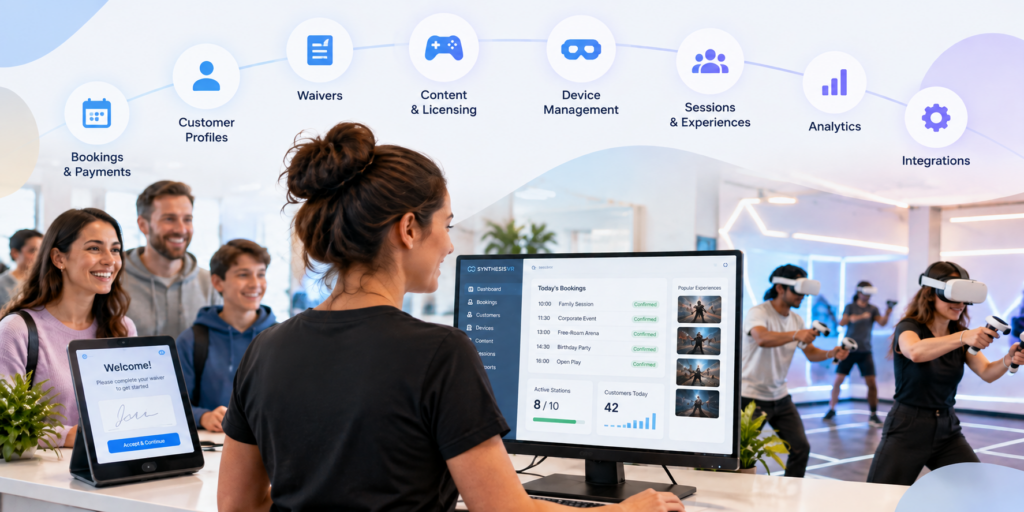
Before a customer even puts on a headset, someone may need to manage the booking, check availability, collect payment, confirm a waiver and connect the visit to a customer profile. Once they arrive, staff still need to prepare stations, launch the right experiences, manage session time and keep track of commercially licensed content.
After the session, there may be feedback to collect, customer history to maintain, memberships to manage and operational data to review.
It is easy for each of those jobs to become a separate piece of software.
But does a VR arcade actually need that many systems?
For many venues, the answer is no. A dedicated VR arcade management platform can bring much of the customer journey and day-to-day operation into one environment, while still connecting to specialist tools when they are genuinely needed.
That is the approach behind SynthesisVR.
What does VR arcade management software actually manage?
VR arcade management software connects the operational parts of running a commercial VR venue.
With SynthesisVR, operators can manage VR devices, content, customers, reservations and commercial licensing within the same ecosystem. Depending on the setup and modules a venue chooses, the platform can also support online bookings and payments, waivers, memberships, gift vouchers, customer feedback, analytics and third-party integrations.
That distinction matters.
The objective is not to replace every piece of business software a venue could possibly use. An operator may still want dedicated accounting, payroll, advanced marketing automation or other specialist systems.
The more useful question is how many separate systems staff need to move between simply to run a VR session and manage the customer around it.
For many venues, that number can be considerably smaller than expected.
Start before the customer reaches the venue
A large part of venue management happens before someone walks through the door.
With the SynthesisVR Booking Widget, customers can see available times and experiences, select session duration and station requirements, and create a reservation directly from a venue’s website. Operators can configure booking rules, available days and other conditions around how those reservations work.
Online payment can also form part of that process. Operators can connect supported payment providers, require deposits, take payment during booking or allow customers to pay at the venue.
The widget can also collect additional customer information and present booking confirmation requirements. A waiver can be incorporated into the booking process as well.
For the operator, the important part is what happens behind the customer-facing page: the reservation is being created within the same operational environment used to manage the venue.
Related resource: SynthesisVR Booking Widget Setup
Customer information does not have to live in another system
A booking is more useful when it is connected to a customer rather than existing as an isolated calendar entry.
SynthesisVR’s customer management tools allow venues to maintain customer profiles and connect those profiles with operational information.
Operators can view registered customers, reservation and session history, membership status, waiver status and account balances. Profiles can also contain additional information and internal notes.
This becomes increasingly useful as a venue develops repeat customers.
Instead of treating every visit as if the guest has never been there before, staff have a record connected to the same system being used to manage their sessions.
This is not intended to replace every function of a specialist CRM. For venues that need broader email marketing or automation, SynthesisVR supports integrations with tools such as MailChimp and ActiveCampaign.
The difference is that core customer information does not have to be separated from the VR operation itself.
From reservation to VR session
This is where a general booking system and software built specifically for location-based VR begin to differ.
A standard reservation platform can tell staff that six people are arriving at 3:00 PM.
A VR management system also has to deal with what happens next.
Which stations will they use? Which experience are they playing? How long is the session? What content needs to be available? Is the customer’s waiver complete? What has been assigned to the reservation?
SynthesisVR connects reservations with the operational side of the session, allowing staff to manage the customer and the VR experience from the same environment.
For a quiet venue with only a few headsets, moving between systems may initially seem manageable. As bookings overlap, group sizes grow or a venue adds more stations and attraction types, those extra steps become much more noticeable.
The goal of consolidation is not simply having fewer browser tabs open. It is reducing the number of manual handoffs required to get a customer from booking to play.
Managing the headsets is part of managing the business
VR hardware creates another layer that conventional booking software does not address.
SynthesisVR provides centralized device and station management, giving operators control over the hardware used across the venue.
It also offers the Smart In-Headset Game Launcher. Players can browse and switch between available games from inside the headset, with features including game categories, trailers, pause controls and a call-for-help option.
That can change the role of venue staff.
Instead of needing to manually intervene every time a customer wants to browse or change an experience, some of that interaction can happen inside the headset. Staff remain available when customers need help, but they do not necessarily need to perform every routine action for them.
For a commercial venue, that distinction becomes increasingly important as the number of active stations grows.
Content management and commercial licensing belong in the same conversation
A VR arcade does not only need games. It needs the right to use those games commercially.
Consumer VR licenses are generally intended for personal use rather than a business charging customers to play. Commercial venues therefore need content that is properly licensed for location-based entertainment.
SynthesisVR combines content discovery and commercial licensing with the management platform. Operators can test, license, install and manage commercial VR content through the SynthesisVR ecosystem, with usage tracking built into the licensing workflow.
Different titles can also use different commercial licensing models, including usage-based and fixed options.
This removes another potential layer from the venue’s software and administrative stack. Content management, licensing and actual venue usage do not have to exist as three unrelated processes.
Related reading: VR Commercial Licensing Explained: What Every New Operator Needs to Know
Free-roam, room-scale and standalone do not need completely separate management worlds
Modern VR venues are becoming more varied.
One location might operate traditional room-scale stations alongside a free-roam arena. Another may use standalone headsets for particular experiences or events. Some venues combine several attraction formats as they grow.
SynthesisVR supports multiple commercial VR formats, including room-scale, free-roam and standalone hardware such as Quest, PICO and Focus 3.
That matters because adding a new attraction does not necessarily have to mean adding an entirely separate operational system around it.
The attraction itself may be different. The surrounding management workflow can remain much more consistent.
Retention tools can sit closer to the actual visit
Getting someone through the door is only part of running an entertainment venue.
SynthesisVR includes built-in tools for memberships, gift vouchers and customer feedback. Memberships can support recurring billing and track customer sessions, while customer profiles preserve the history surrounding individual guests.
Feedback can also be incorporated into the post-session journey rather than becoming a completely separate manual process.
These tools become more useful when they connect to what actually happened in the venue.
A membership is not just a name on another subscription list. It can be associated with the customer’s account and visits. A customer record can show session history. Feedback can follow an actual experience.
That connection between the customer and the operation is one of the advantages of keeping these functions close together.
What should stay outside your VR management platform?
Consolidation should not become an objective for its own sake.
A venue may already have a booking provider that works well. It may rely heavily on a particular email marketing system. Larger businesses may have established processes that extend far beyond VR operations.
In those situations, replacing a working system simply to reduce the number of software products may create more work rather than less.
This is why integrations matter.
SynthesisVR supports third-party services including FareHarbor, Checkfront, Google Calendar, MailChimp and ActiveCampaign. It also provides API and webhook access, WordPress support and web widgets for businesses that need more customized workflows.
Payment processing follows the same principle. Rather than positioning SynthesisVR as a conventional point-of-sale replacement, the platform can connect supported payment processors such as Stripe, Square, WorldPay and Moneris to relevant customer and booking workflows.
The better model is therefore not necessarily one piece of software for absolutely everything.
It is one central operational system, with specialist tools connected where they add value.
Before adding another subscription, check what your existing platform already does
Software stacks often grow one problem at a time.
A venue needs online booking, so it adds a booking tool. Waivers come next, followed by memberships, customer records and perhaps another solution for feedback. Meanwhile, VR stations and commercial content still require their own management and licensing workflows.
Each decision can make sense individually.
The complexity appears later, when staff have to make those systems work together during a busy operating day.
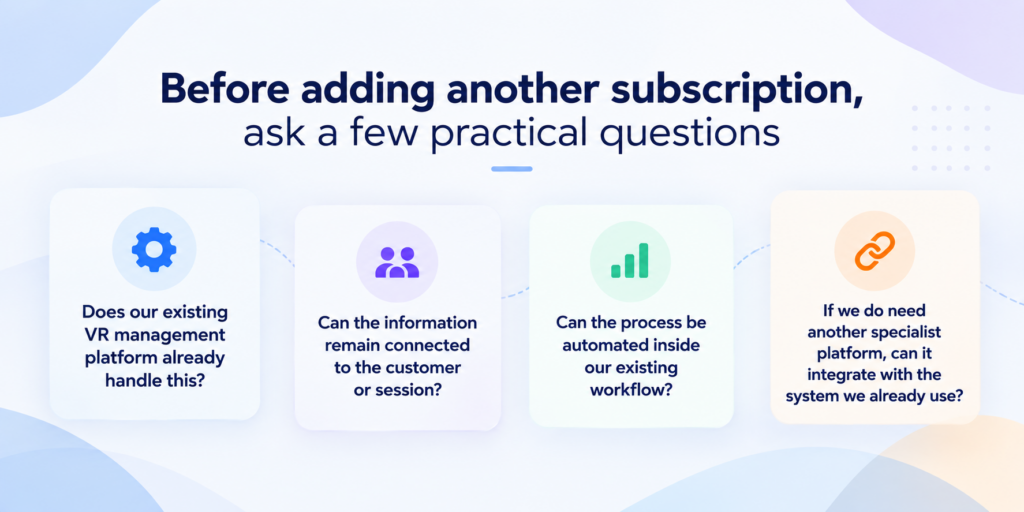
Those questions are particularly important for growing venues. What feels like a minor manual step across four stations can become a very different operational burden across ten, twenty or multiple locations.
One platform does not mean one way of operating
There is another reason we think this distinction matters.
VR venues are not identical.
An arcade built around hourly room-scale sessions does not operate like a free-roam attraction. A family entertainment center adding VR has different requirements from a dedicated VR arcade. A multi-location operator has different needs again.
The purpose of an all-in-one VR management platform should therefore not be to force every operator into the same workflow.
It should reduce the number of disconnected systems required to build the workflow that fits the venue.
SynthesisVR can be used as a centralized management and commercial content licensing platform, with additional modules and integrations added according to the needs of the business.
For some operators, that may mean a relatively simple setup focused on station management and commercial content. For others, it can extend across booking, online payments, customer profiles, waivers, memberships, feedback, integrations and more.
The important question is not how many features a platform has.
It is how many everyday operational problems those features prevent staff from having to solve somewhere else.
So, how much software does a VR arcade actually need?
Probably less than you think.
A commercial VR venue still needs specialist tools where they make sense. But booking, customer management, session management, device control, commercial content licensing, memberships, waivers, feedback and other core venue workflows do not necessarily need to exist in separate systems.
Bringing more of those functions together reduces the number of handoffs between the customer, the front desk and the VR floor.
And that is ultimately the point.
The best venue technology is not the software your customers notice. It is the infrastructure that allows your team to spend less time managing software and more time running the experience.
Explore the SynthesisVR features to see what can be managed within the platform. If you want to learn more about how SynthesisVR could fit your venue or would like to schedule a demo, contact our team.