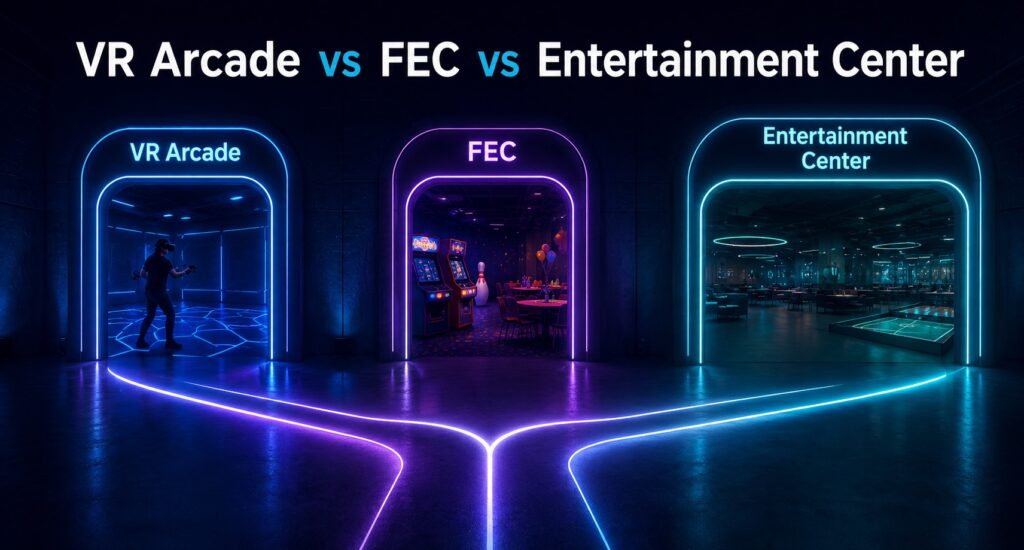
A venue can call itself a VR arcade while running a free-roam arena, a party room, a full bar, and a birthday package that barely mentions headsets. Another venue can run twenty arcade machines and a snack counter and call itself an entertainment center. The name on the door tells you almost nothing.
What matters is what the venue sells and how it builds the visit. A VR arcade earns most of its attraction revenue from VR sessions. An FEC spreads the visit across several attractions, events, food, and other revenue streams. For operators, the useful question isn’t which label fits. It’s what business model you’re actually running.
A VR Arcade Runs on Session Revenue
A VR arcade makes virtual reality the main reason to visit.
The setup varies. One location runs six room-scale PCVR stations. Another runs a four-player free-roam arena. A larger arcade combines room-scale, free-roam, racing simulators, and several multiplayer formats.
What connects them is the role VR plays in the business. The venue earns most of its attraction revenue by selling access to VR experiences. Staff spend their time managing headsets, launching sessions, onboarding players, maintaining equipment, selecting commercial content, and moving groups through available capacity.
That makes a specific set of numbers matter:
- session utilization
- revenue per available station or arena
- group size
- session turnaround
- content performance
- repeat visits
- downtime
A six-headset arcade with one empty station loses sellable VR capacity. A free-roam venue that turns away six-player groups because its strongest experiences only support four faces a different capacity problem. Either way, VR sits at the center of the operating model.
Related reading: How Do VR Arcades Actually Make Money?
A Family Entertainment Center Sells the Whole Visit
A family entertainment center, usually shortened to FEC, gives guests several activities in one location.
The mix varies by venue: arcade and redemption games, bowling, laser tag, mini-golf, climbing, trampolines, indoor play, VR, party rooms, food and beverage. IAAPA treats family entertainment centers and location-based entertainment venues as major parts of the attractions industry, and its current FEC resources include immersive VR and interactive gaming within the attraction mix.
That wider mix changes the business. A family arrives for a birthday party, spends time in the arcade, plays a VR attraction, orders food, and finishes with another activity. The operator has several chances to earn revenue during one visit, and more moving parts to coordinate: staffing, floor allocation, maintenance, food service, party schedules, attraction capacity, guest flow. VR has to work within that larger system, not run it.
“Entertainment Center” Doesn’t Mean Much on Its Own
People use the term for many location-based entertainment businesses, including FECs, arcades, immersive attractions, bowling venues, escape-room businesses, and mixed entertainment concepts.
The name alone tells an operator very little. A business called an “entertainment center” might run twenty arcade machines and a snack counter. Another might cover several thousand square feet with bowling, VR, event rooms, food service, and multiple ticketed attractions. Look at attraction mix and revenue model before relying on the category name.
VR Arcade vs FEC: Where the Business Models Split
The clearest distinction shows up when you follow the customer journey and the money behind it.
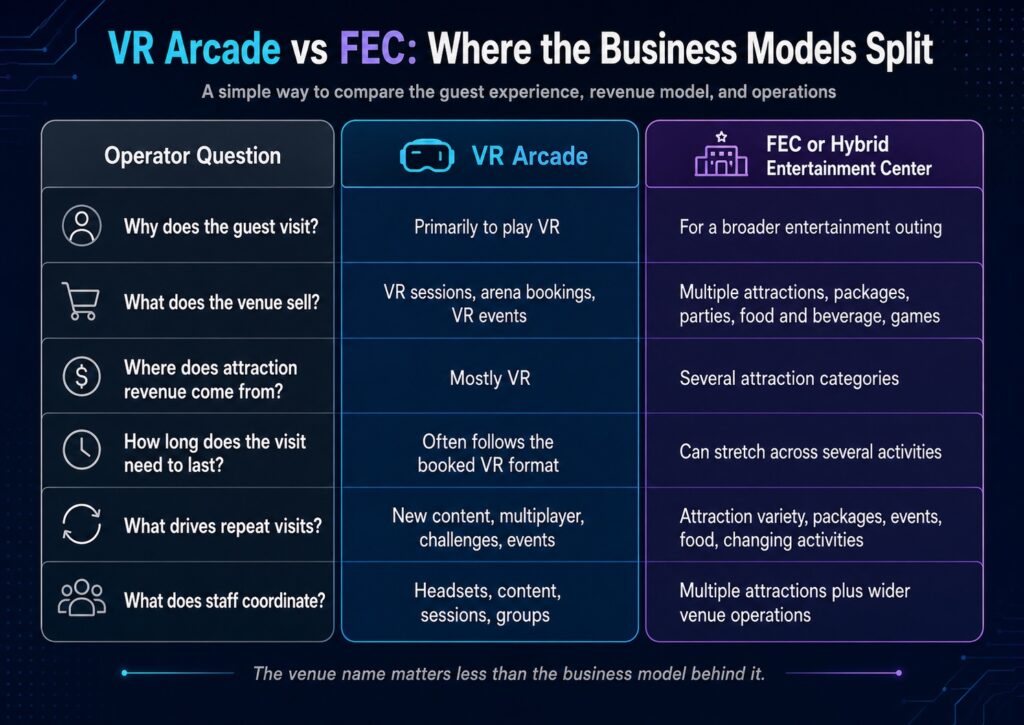
There’s no attraction count that automatically turns a VR arcade into an FEC. A venue can run several types of VR and stay a VR-first business. Room-scale PCVR, standalone free-roam, escape experiences, and racing can all serve different audiences while VR stays at the center of the visit. The shift happens when the wider venue starts carrying more of the customer experience and more of the revenue.
The Sign Above the Door Can Stay the Same While the Business Changes
Picture a venue that opens with eight room-scale VR stations. Customers book headset time, choose games, leave when the session ends.
The operator adds a four-player free-roam arena. That changes the content mix and opens larger group bookings, though VR still drives the business.
Then birthday demand grows. The venue adds a party room and builds two-hour group packages. Guests now spend part of the booking playing and part of it socializing.
Food and drinks follow, because it works well while one group waits for the arena.
The business still has “VR Arcade” on Google Maps. Operationally, it now behaves much more like a mixed entertainment venue. Each additional revenue line changes what the operator needs to optimize. Headset utilization still matters, but so do dwell time, package value, attraction flow, party capacity, and how much each group spends across the whole visit.
Why VR Arcades Often Expand Their Attraction Mix
A VR-only business has one clear advantage: focus. Staff learn one category deeply. Marketing stays clear. A small venue can concentrate its capital and floor space around a limited number of systems.
That focus also creates a limit. A first-time customer can have a strong session and still ask a hard question three months later: what would I come back to do next?
Content rotation solves part of that. Multiplayer formats, free-roam VR, VR escape rooms, competitive games, and different session lengths create variety without asking the operator to enter another attraction category. That’s why content strategy matters so much in a VR arcade.
Some venues go further and add events, food, spectator areas, party space, or non-VR activities, because their customers are buying a wider occasion. The birthday parent wants a complete party. The corporate organizer wants a two-hour team event. A group of friends wants somewhere to spend the evening. At that point, selling headset minutes alone can undersell what the customer is actually buying.
Related reading: How Often Should VR Arcades Rotate Their Content?
Where VR Fits Inside an FEC
The same VR attraction plays a different role once it enters an existing FEC.
Take an FEC that already has bowling, redemption games, food, and birthday rooms. It doesn’t need VR to carry the venue. The attraction can instead give the business a premium multiplayer option, pull in older kids and adults, add another slot to party packages, or give repeat guests something new to book.
That changes what the operator needs to ask:
- Does the attraction suit our existing group sizes? A two-player experience works well in one venue and creates queues in another.
- How does the session length fit the wider visit? A 45-minute free-roam experience affects a party itinerary differently than a 10-minute attraction.
- Who will operate it? An attraction needing constant staff intervention creates a different labor requirement than one staff can launch and monitor alongside nearby activities.
- Will guests have a reason to play again? A visually impressive attraction can still struggle if customers see it as a one-time experience.
- Does it fit our existing audience? A venue built around families with younger children needs a different VR mix than one serving teens, adults, and corporate groups.
For an FEC, VR earns its place by contributing to the whole venue, not by standing apart from it.
Three Venues, Same Hardware, Three Different Businesses
Venue A: The VR-first arcade. Six PCVR stations and a free-roam arena. Customers choose room-scale games or multiplayer arena sessions; group bookings and birthday parties use the same VR capacity. The operator watches station utilization, content rotation, group sizing, session throughput, and repeat behavior closely.
Venue B: The VR-led social venue. Same equipment, plus a dedicated event room, drinks, longer private bookings, and organized group packages. VR still anchors the visit, but the venue now earns more from the occasion around the session. Scheduling and package design start to matter almost as much as headset utilization.
Venue C: The FEC with VR. Already runs several attraction categories. The free-roam arena becomes one choice within a longer visit. The operator measures whether VR raises package value, helps sell events, reaches an audience other attractions miss, and earns enough from its floor space.
Same category of technology. Very different job.
Related reading: How Many Players Should a VR Attraction Support?
Five Questions That Show Where a Venue Actually Sits
There’s no formal line an operator crosses. Adding a vending machine doesn’t turn a VR arcade into an FEC. Neither does adding a party room. Instead, look at:
- Attraction mix. How many genuinely different activities can guests buy?
- Revenue mix. How much income now comes from outside VR sessions?
- Visit structure. Do guests come for one VR booking or a broader outing?
- Operations. Does the team manage one attraction category or coordinate several?
- Marketing. Are you selling VR itself, or birthdays, nights out, family visits, and events through a mix of attractions?
The answers show where the business sits more clearly than the venue name does.
Match the Model to the Space, Not the Label
A larger entertainment center isn’t automatically a stronger business. A smaller VR arcade isn’t automatically an easier one. Start with the customer and the use case.
A compact location with limited capital may do better building depth around a smaller VR footprint. Multiple experiences can run through the same headset fleet, which gives the operator ways to refresh the offer without rebuilding the venue.
A larger site with several customer segments may have room for a broader attraction mix, supporting longer visits and more types of bookings, though it also brings more equipment, staffing, maintenance, and operational decisions.
The right model depends on available space, startup capital, local audience, typical group size, staffing, booking patterns, session throughput, attraction mix, and repeat-visit strategy. Those decisions should come before the label does.
As the Attraction Mix Grows, the Operational Layer Has to Keep Up
A VR-led venue can add real variety without leaving VR. One day might include room-scale PCVR, a free-roam group, a birthday booking, competitive multiplayer, and a different content selection for younger players. Staff still need to keep sessions moving while monitoring the headset fleet and keeping commercial content ready to launch.
SynthesisVR supports that layer through commercial VR content management, session control, fleet management, and access to a VR content marketplace, whether you’re running a standalone arcade or fitting one arena into a much larger venue.
See how SynthesisVR handles fleet and content management across all three models.