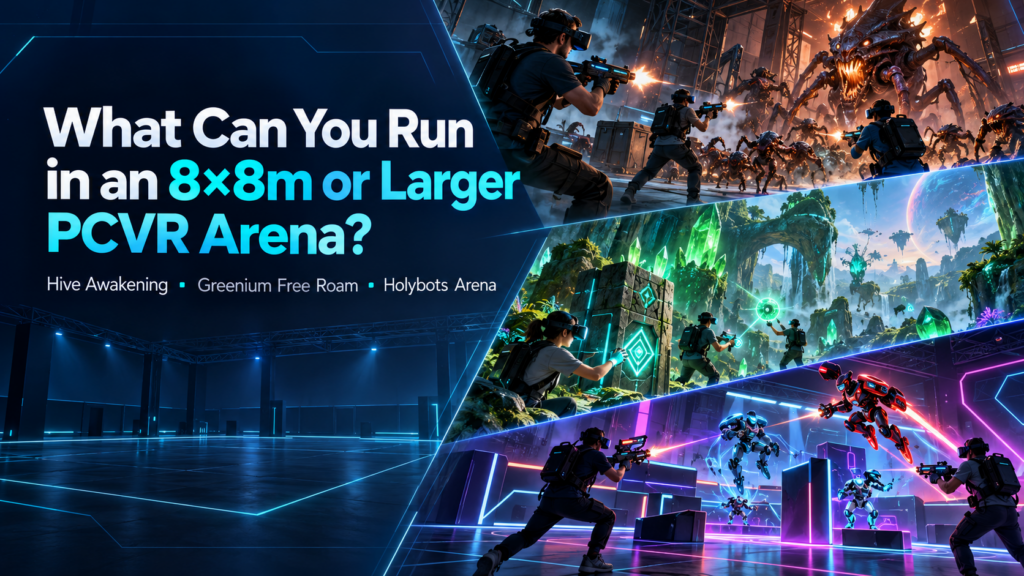
Once a VR venue dedicates 64 square meters or more to a free-roam attraction, content selection becomes a bigger operational decision.
The physical space can support experiences that give groups considerably more freedom to move, but arena size alone does not determine how that space performs commercially. Player capacity, game format, audience fit, replayability, and the variety of experiences available for the same footprint all matter.
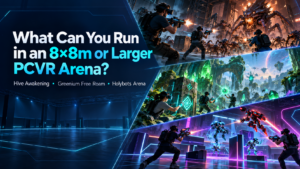
For this article, we are looking specifically at PCVR free-roam experiences with configurations of 8×8 meters or larger. Three titles on the SynthesisVR marketplace illustrate how differently operators can use that space: Swarms: Hive Awakening, Greenium Free Roam, and Holybots Arena.
What changes when a PCVR arena reaches 8×8 meters?
An 8×8 meter play area gives operators 64 m² of shared physical space. A 10×10 meter arena increases that to 100 m², while some configurations go considerably further.
That additional room matters because free-roam gameplay can use physical movement as part of the experience. Players can spread out, reposition themselves, work together across a shared environment, or compete for control of the arena.
The commercial question is therefore larger than, “Will this game fit?”
Operators also need to ask what audiences the arena can serve and how many different reasons they can give customers to book the same physical attraction.
The three examples below show how one broad arena category can accommodate cooperative action, puzzle-driven adventures, and competitive PvP.
Swarms: Hive Awakening: PCVR free roam at serious scale
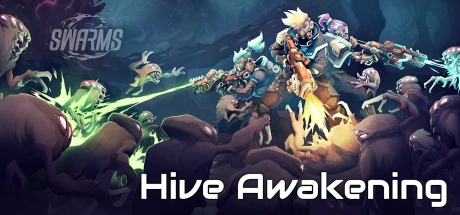
Swarms: Hive Awakening supports two notably large configurations:
| Arena | Players |
| 8×8 m | 1–8 |
| 16×12 m | 1–8 |
The 16×12 meter option is particularly interesting because it represents 192 m² of playable space.
In Hive Awakening, players form a team of elite fighters sent to the Corigis-B12 mining facility to stop an invasion. The cooperative format gives operators a clear group experience for friends, parties, and teams that want to play together rather than rotate through individual stations.
For an operator, Hive Awakening also demonstrates an important point about large-arena PCVR. Once a venue can support eight players across a substantial shared area, the attraction starts functioning as a group destination within the venue rather than simply another headset activity.
The larger configuration also raises practical questions about floor allocation, networking, PC infrastructure, staff supervision, and how frequently the venue can fill an eight-player session. Those factors should be considered alongside the experience itself when planning an arena of this size.
Greenium Free Roam: using a large arena for puzzles and cooperation

Large free-roam arenas do not have to revolve around combat.
Greenium Free Roam takes a different approach. Players become scientists exploring a distant planet, solving puzzles, confronting poachers, and upgrading their ship while working together to secure valuable crystals.
Its available configurations scale progressively with both space and group size:
| Arena | Players |
| 8×8 m | 2–8 |
| 9×9 m | 2–9 |
| 10×10 m | 2–10 |
The title can therefore scale from an eight-player 64 m² arena to a ten-player 100 m² setup.
That makes Greenium useful when thinking about attraction variety.
A venue may have customers who enjoy free-roam VR but are less interested in a pure shooter. Cooperative puzzles and exploration give operators another way to use the same physical investment while targeting groups looking for teamwork and shared problem-solving.
It also illustrates why player count matters alongside square meters. Expanding from an 8×8 to a 10×10 configuration can increase the supported group from eight to ten players, which may affect how an operator structures private bookings, parties, or group packages.
Holybots Arena: turning the same footprint into competitive PvP
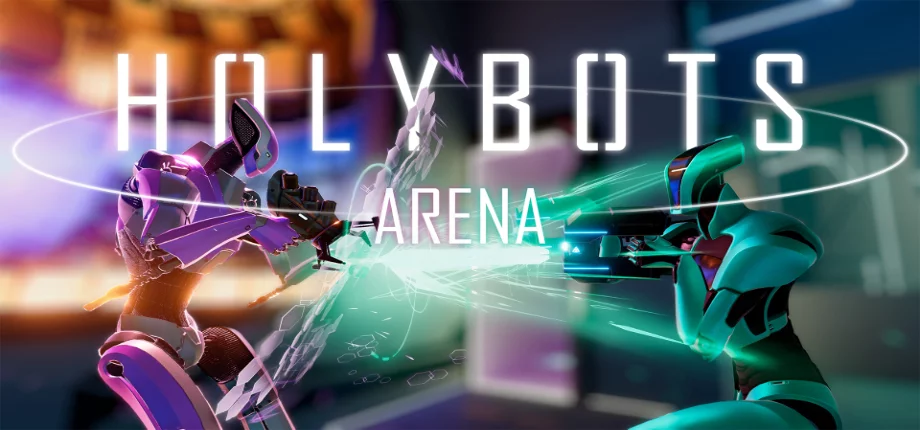
Holybots Arena brings another format into the mix: fast-paced player-versus-player free-roam.
Players choose an archetype and enter a futuristic robot arena, turning the physical space into a competitive multiplayer environment.
Its larger configurations include:
| Arena | Players |
| 8×8 m | 2–4 |
| 9×8 m | 2–6 |
| 9×9 m | 2–6 |
| 10×10 m | 2–8 |
This creates a different operational proposition from either Hive Awakening or Greenium.
Rather than bringing a large cooperative group through one shared adventure, operators can use the arena for competitive matches that encourage players to challenge friends, change strategies, and play again.
That difference becomes important when planning a content library. A venue with one large PCVR arena may want experiences that give customers genuinely different reasons to return rather than several titles that deliver essentially the same style of session.
One large arena can support very different attraction formats
These three titles show why arena size should be considered together with content strategy.
Hive Awakening can use an exceptionally large 16×12 meter space for an eight-player cooperative experience. Greenium Free Roam scales up to 10×10 meters and ten players while emphasizing puzzles and teamwork. Holybots Arena uses up to 10×10 meters for competitive PvP.
The hardware investment and floor allocation behind a large PCVR arena may remain relatively stable while the guest experience changes considerably.
That gives operators an opportunity to think about the arena as a flexible attraction platform.
A group might visit for a cooperative science-fiction campaign one month, return for a puzzle-focused adventure, and later compete against each other in PvP. Content rotation can therefore help make the physical space useful to more than one audience and create additional reasons for previous visitors to come back.
Before dedicating 64 to 192 m² to free-roam VR
Larger arenas also carry a larger opportunity cost.
Every square meter devoted to VR could otherwise hold another attraction, seating, party space, circulation, or revenue-generating equipment. Operators therefore need to evaluate more than the maximum supported dimensions.
Look at realistic group sizes, expected utilization, session flow, hardware requirements, staff involvement, and the number of experiences that can run within the chosen configuration.
An arena that technically supports ten players only creates ten-player capacity when the venue can consistently attract, onboard, and operate those groups.
The strongest setup is usually one where the space, player capacity, content mix, and target audience make sense together.
Managing a larger PCVR content mix
As the attraction grows, managing different games, player groups, and session configurations can become more complex.
SynthesisVR gives commercial VR operators a central environment for managing content and sessions across their VR setup. For venues running PCVR free-roam attractions alongside other VR formats, this can help keep the operational layer consistent while the content available to customers changes.
The SynthesisVR marketplace includes PCVR, room-scale, free-roam, and standalone experiences, allowing operators to evaluate content according to the hardware and physical setup they already operate.
Large arenas create more possibilities when the content earns the space
An 8×8 meter arena represents a significant commitment of venue floor space. At 16×12 meters, that commitment becomes considerably larger.
The value comes from what operators can do with it.
Hive Awakening, Greenium Free Roam, and Holybots Arena demonstrate three very different uses of large-scale PCVR: cooperative action, puzzle-driven teamwork, and competitive PvP.
For operators already running a large free-roam space, or planning one, the more useful question may therefore be less about finding a single headline game and more about building a content mix that keeps that arena useful across different audiences and repeat visits.
Explore PCVR free-roam experiences available through SynthesisVR and see which configurations fit your venue.