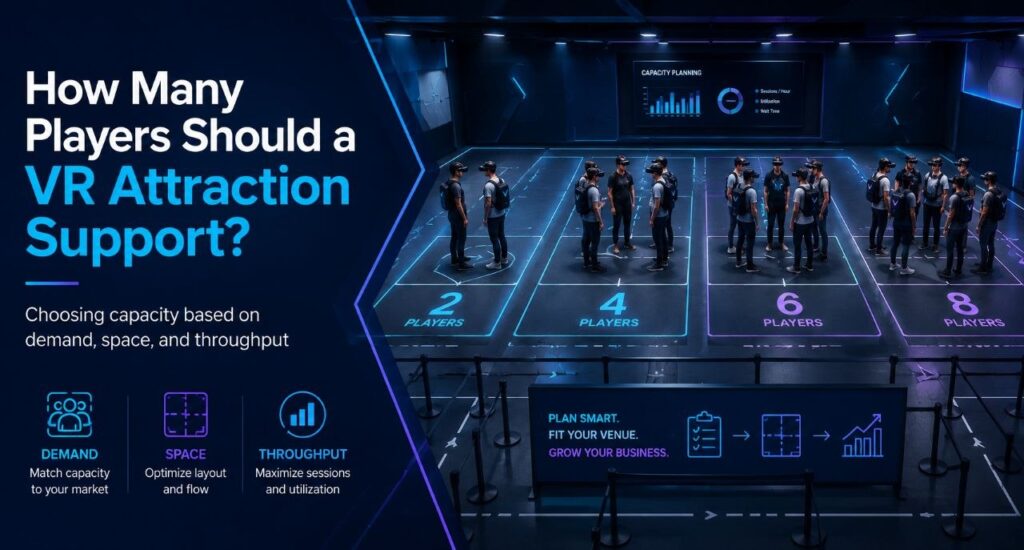
Often operators start this question backward. They decide they want to serve eight guests at once, then go looking for an eight-player attraction. But eight simultaneous guests can mean an eight-player arena, two four-player arenas, a six-player arena plus two room-scale stations, or eight independent room-scale units. Same peak capacity, four completely different businesses.
Player count is what falls out at the end of a chain of choices that starts with your building and ends with your content.
The decision chain
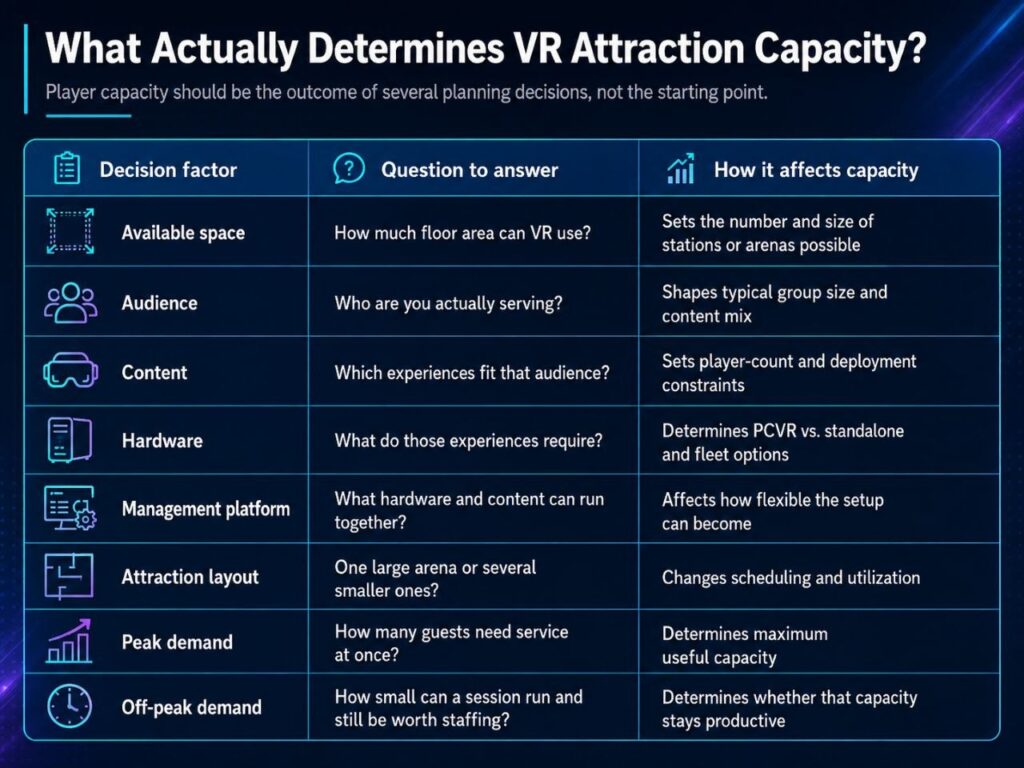
Venue type sits inside this chain as context, not as the formula. A bowling center adding VR, a dedicated VR arcade, and an FEC building around group bookings all answer these questions differently, but none of them get to skip straight to “buy for six” or “buy for eight.”
Start with the space you actually have
Square footage sets the physical ceiling before anything else gets decided. It determines whether you’re looking at room-scale stations, one free-roam arena, several smaller arenas, or some mix of the two. A venue with 400 square feet to spare is choosing between formats before it ever gets to player count.
This is also where the first real tradeoff shows up. The same footprint that holds one eight-player arena can often hold two four-player arenas instead, and those two setups behave nothing alike once you get past the headline number.
Hardware, platform, and content: a triangle, not a checklist
These three choices constrain each other, and there’s no clean order to work through them. Already own PICO headsets? That narrows content options before player count ever comes up. Chasing one specific title instead? PCVR might be the only place it runs, so hardware follows the content rather than the other way around. Running multiple locations changes the order again: many operators pick the management platform first, since one system across different hardware types matters more than any single game.
Whichever one you decide first, it limits what the other two can be. Content needs specific hardware. Hardware needs a platform that can run it and report on it. The platform needs to support whatever mix of standalone, PCVR, wired, or streamed setups the content demands.
What your audience actually needs from content
This is usually the missing step in capacity planning, and it’s the one that should come before arena size gets decided. Birthdays, families with young kids, teenagers, enthusiasts, corporate groups, school trips, escape-room fans, and casual walk-ins all pull the content mix in different directions. A venue built around birthday packages needs different titles, and different group sizes, than one built around enthusiast repeat visits.
Once you know who’s walking in, the content question gets specific. What do those guests want to play, and how many of them want to play it together?
What that content requires
Content is where the constraint actually bites. Free roam versus room scale, PCVR versus standalone, arena dimensions, and player count all come from the title itself, not from how many headsets you own.
Most free-roam titles top out at four or six players in a single configuration. Buying eight headsets doesn’t change that. It just means eight headsets sitting on a shelf while the content that fits your audience runs four at a time.
Take the two four-player arenas versus one eight-player arena question from the top of this piece. The two-arena setup gives an operator more compatible titles at that smaller player count, two bookings running at once, and better use of small-group demand on a normal Tuesday, while still hitting eight total players when both arenas are booked together on a Saturday. The eight-player arena gives up all of that flexibility for a configuration that only earns its keep when a full group of eight actually shows up.
Neither is automatically the right call. It depends on what your audience actually books.
Peak capacity and weekday utilization are different problems
VR attraction planning works better when you separate peak demand from utilisation. This is the commercial core of the whole decision, and it’s easy to miss.
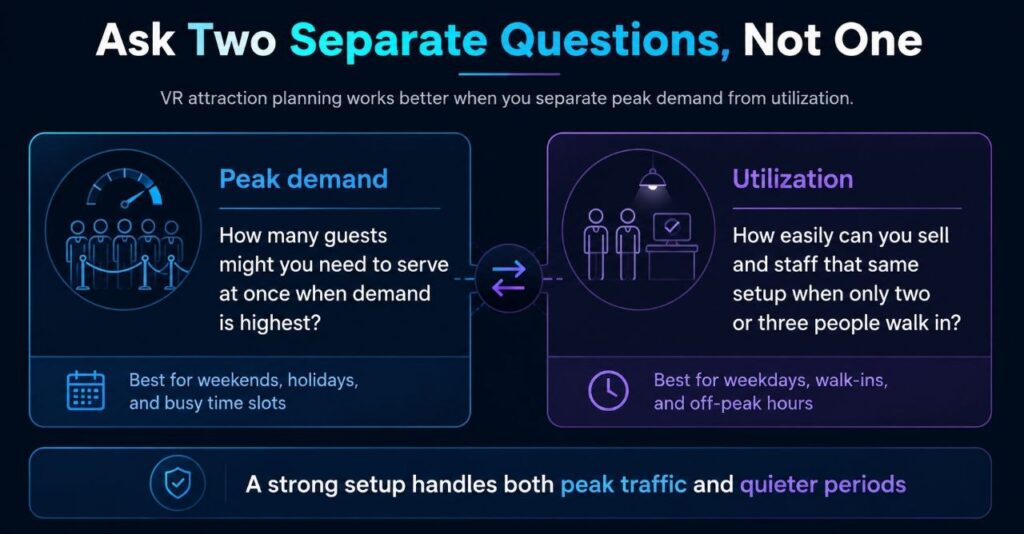
Picture a Tuesday afternoon. A group of three arrives at a venue built as one eight-player arena. The operator can run that group at three of eight positions filled, or hold the session and wait for another group to fill the rest. Either way, most of that capacity sits idle for a slot that will never come close to selling out again before Friday.
The same group at a venue built as two four-player arenas gets a session at three of four positions filled, close to full, while the second arena stays open for the next booking or for maintenance. Same total headset count as the eight-player venue. Very different Tuesday.
A big configuration built for the weekend peak can leave a lot of equipment sitting unused Monday through Thursday. A modular setup, several smaller arenas or stations instead of one large one, can often handle the same peak while giving staff something sellable on a slow afternoon. Getting people through the building midweek is usually the harder problem than filling Saturday, and configuration is one of the few levers that actually moves it.
The fleet model: capacity that changes shape
A venue with a larger headset fleet doesn’t have to run the same configuration all week. The same hardware can be deployed differently depending on who’s booking:
- Weekday walk-ins get smaller, faster sessions
- Birthday bookings get multiplayer free-roam groups
- A corporate event gets one large coordinated group
- A school visit spreads across many devices running educational content
- An enthusiast booking gets PCVR access to a specific premium title
Capacity, in other words, doesn’t have to be fixed. It can flex by day and by booking type, which is a very different planning question than “large FEC equals eight to sixteen players.”
This is also where a management platform earns its cost. Running PICO, Quest-compatible, and PCVR hardware side by side, and reconfiguring which content runs where as bookings change, needs one operational layer that can see and control all of it. SynthesisVR is built for exactly that: managing hardware, content, and session formats as one system instead of as separate silos an operator has to reconcile by hand.
Configuring the venue around your content
Once space, audience, hardware, and content are settled, the player-count question finally has something to answer. The goal isn’t the largest number available. It’s the configuration that gives the venue enough peak capacity while keeping the widest useful content selection and the most flexibility during quiet periods.
That might be one large arena if you’re selling scheduled group experiences and want everyone playing together. It might be several smaller arenas if bookings arrive in different sizes at different times through the week. It might be a fleet that shifts shape depending on the day. The right answer comes from the chain above, not from a table that maps venue type straight to a player count.
The version worth remembering is simpler than the chain above: figure out your space, your hardware and platform, and your audience’s content first. The player count follows, not the other way around.