Competitive shooters and wave-based action games still dominate a lot of conversation around location-based VR content, but cooperative adventures hold a steady, important place in most successful attraction libraries. Operators running a single-genre lineup often miss a segment of guests who are not looking to compete at all.
For families, corporate teams, birthday parties, and mixed-experience groups, a shared objective creates an easier entry point than direct competition. Instead of measuring individual performance, players solve problems together, explore an environment as a unit, and move through challenges as a team. Nobody has to “win.” The group either escapes, or it does not.
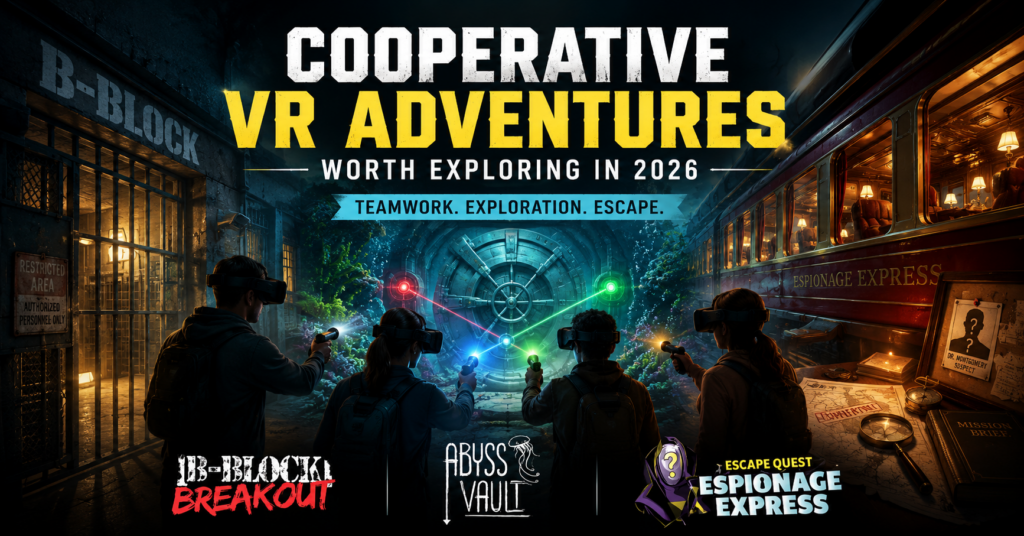
Three current titles on the SynthesisVR marketplace show just how differently cooperative multiplayer can approach that same basic goal.
Abyss: Vault: Exploration Through Teamwork
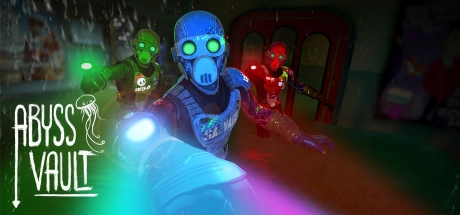
Abyss: Vault drops a rebel squad into an underwater vault to recover what its owners hoarded. The vault fights back. Players carry different coloured light weapons (red, blue, or green) and have to combine beams to open doors and power systems as they push deeper. A mechanical crab guards the final stretch, and the game makes a point that lone players do not make it out. Coordinated squads do.
This is a free roam title built for Pico, Quest, and Focus 3 headsets, with a footprint of roughly 19.7 x 19.7 ft (6.0 x 6.0 m) for 2 to 6 players.
Operator angle: Groups looking for a longer-form adventure, rather than a high-intensity action session, tend to gravitate toward this kind of pacing. The colour-coded mechanic also gives operators an easy way to explain the experience to first-time players in under a minute.
Escape Quest: Espionage Express: Solving Problems Together

Escape Quest: Espionage Express puts players on a hacked train, chasing a saboteur named Dr. Montgomery through physics-based puzzles and a ticking clock. It leans on logic and observation rather than combat, and the studio built it specifically for players who are new to VR and still getting comfortable with the medium.
The title runs on PCVR and standalone room-scale setups (Pico, Quest, Focus 3). A June 2026 update moved the game to a fully offline, LAN-based multiplayer system, removed the separate spectator subscription requirement, and added native support for standalone Pico headsets, so server and spectator-screen setup is simpler than it used to be.
Operator angle: Escape-room style experiences often appeal to guests who do not think of themselves as gamers at all. It is a useful bridge title for venues trying to convert non-gaming groups, like a birthday party booked by a parent who has never picked up a controller.
B Block Breakout: Collaboration Under Pressure
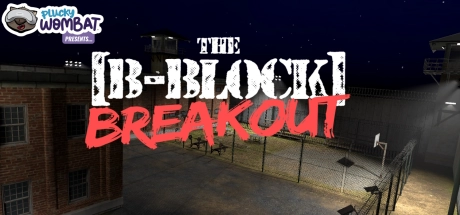
B Block Breakout sends a group of scoundrels through a high-security prison they need to escape together. The game leans into atmosphere first: detailed prison interiors, a tense pace, and puzzles that depend on logic, deduction, and the occasional bit of luck. An auto-hint system can run on its own or be controlled by a Game Master watching the session, which gives operators flexibility on how hands-on they want staff to be during a playthrough.
B Block Breakout supports both free roam (16.4 x 18.0 ft / 5.0 x 5.5 m, 2 to 6 players) and standalone or PCVR room-scale play across Pico, Quest, and Focus 3 headsets, giving operators flexibility depending on arena size.
Operator angle: The strongest cooperative experiences tend to create their memorable moments through group problem-solving rather than combat, and this title is a clean example. The flexibility between free roam and room-scale setups also means it can fit venues that have not built out a larger free roam arena yet.
Why Cooperative Experiences Matter for Commercial Venues
This is the part that actually moves the needle for a venue’s calendar.
Families do not always want to compete against each other, especially with a wide age range in the group. Birthday parties tend to book better when the activity does not single out a “winner” and a string of “losers” among ten-year-olds. Corporate groups often specifically request team-building framing, and a cooperative VR session delivers that without anyone needing to plan a contrived exercise. Mixed-age and mixed-experience groups, where a grandparent and a teenager are playing side by side, benefit when the format rewards communication over speed or precision.
Cooperative titles also carry strong spectator appeal. A family member watching the action on a monitor screen is more engaged with a heist or escape unfolding than with a leaderboard updating. That spectator moment often turns into the next booking, since the person watching today is frequently the one calling to book a session next month.
For VR arcade and FEC operators building a content rotation, the mix matters more than any single title. A LBE VR platform like SynthesisVR makes it straightforward to license titles like Abyss: Vault, Escape Quest: Espionage Express, and B Block Breakout alongside the rest of a venue’s catalogue, so operators can balance cooperative and competitive content without managing several separate vendor relationships.
Final Takeaway
Successful multiplayer attractions do not all rely on competition. Cooperative adventures offer a different kind of social experience, one built on communication, teamwork, and shared achievement rather than individual scorekeeping. For most venues, keeping a mix of competitive and cooperative content on the schedule means there is something that fits every group that walks through the door, whether that is a stag party looking for a shootout or a family of five who just want to escape a train together.
Related Reading
What Is the Difference Between Room-Scale and Free-Roam VR?
How VR Arcades Fill Empty Weekday Sessions Without Discounting
VR Room-Scale Classics Every VR Arcade Operator Should Know About